
Workplace setbacks don’t announce themselves. One moment you’re leading a project, the next you’re watching it unravel. Your manager questions your decisions. A colleague takes credit for your work. Deadlines pile up faster than you can clear them. These moments test something deeper than your skills or experience. They test your mental resilience.
[Mental resilience](https://www.apa.org/topics/resilience) is your ability to recover from professional setbacks and adapt to ongoing stress. Building it requires specific practices: reframing negative thoughts, maintaining strong support networks, developing emotional awareness, creating recovery routines, and learning from failures. These aren’t quick fixes but sustainable strategies that strengthen over time, helping Singapore professionals handle workplace challenges without burning out or losing confidence in their abilities.
What mental resilience actually means for working professionals
Mental resilience isn’t about never feeling stressed. It’s not about maintaining a perfect poker face when everything falls apart. That’s suppression, not strength.
Real resilience is your capacity to face difficulty, process it honestly, and move forward without letting it define you. It’s the difference between a bad quarter destroying your confidence and using it to refine your approach.
Think of it like physical fitness. You don’t build muscle by avoiding heavy things. You build it by lifting, recovering, and lifting again. Mental resilience works the same way.
Singapore’s work culture adds unique pressures. Long hours are normalized. Taking mental health days still carries stigma in many industries. The expectation to perform consistently, regardless of personal circumstances, creates a pressure cooker environment.
This makes resilience less optional and more essential. Without it, you’re one major setback away from burnout.
The cognitive reframing technique that changes everything
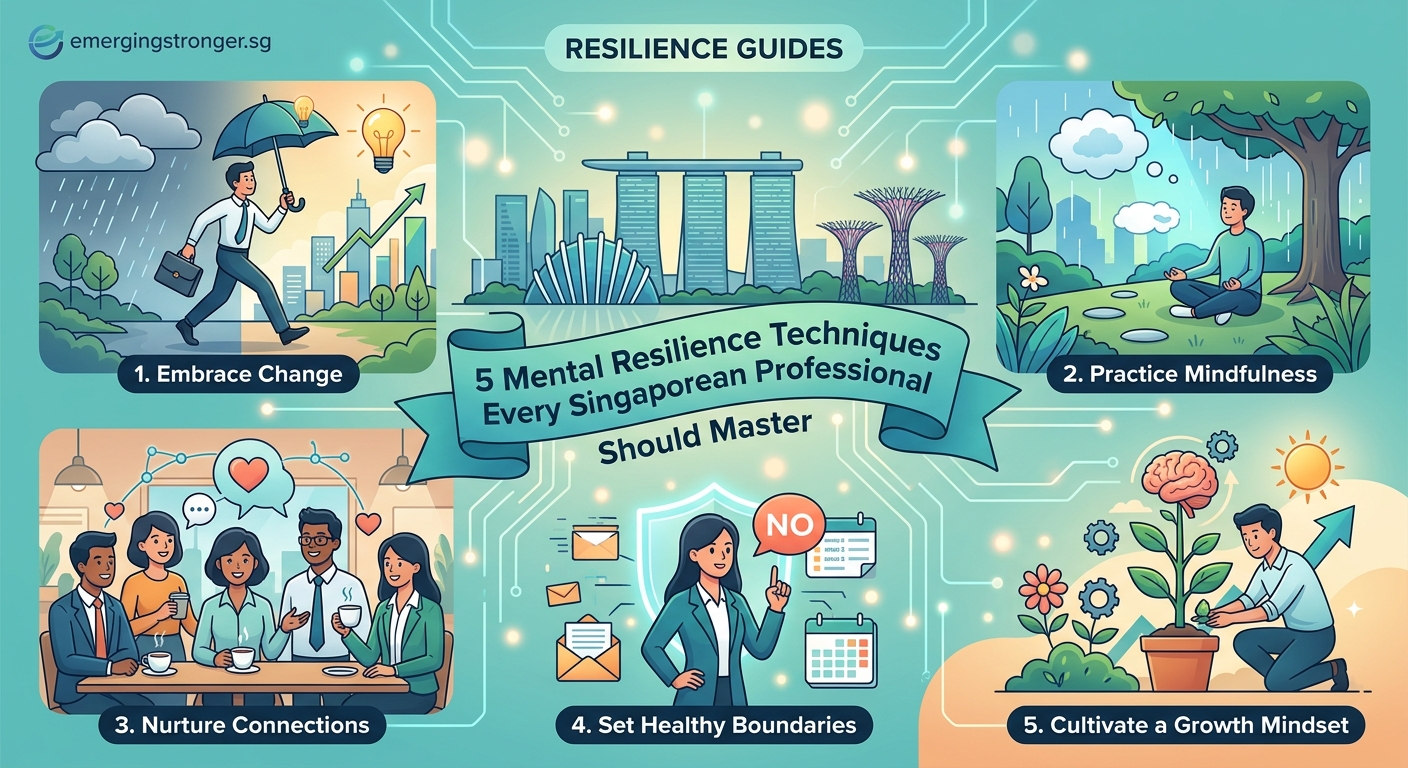
Your brain loves patterns. When something goes wrong, it immediately searches for similar past experiences. If you’ve been criticized before, new criticism triggers the same emotional response, even if the context is completely different.
Cognitive reframing interrupts this pattern. It’s the practice of consciously examining your automatic thoughts and testing whether they’re accurate or helpful.
Here’s how it works in practice:
- Notice the automatic thought. When your manager gives harsh feedback, your brain might say “I’m terrible at my job.”
- Challenge its accuracy. Is that objectively true? Have you succeeded at other tasks? Do other people value your work?
- Generate alternative explanations. Maybe the feedback reflects one specific skill gap, not your overall competence. Maybe your manager is under pressure and communicated poorly.
This isn’t about pretending problems don’t exist. It’s about seeing them clearly instead of through the distorted lens of anxiety or past trauma.
A marketing manager I know used this technique after losing a major client. Her initial thought was “I’ve destroyed my career.” After reframing, she recognized that market conditions had shifted, the client’s budget had been cut, and she’d actually done solid work with limited resources. She still felt disappointed, but the catastrophic narrative lost its power.
The key is practice. Your brain won’t naturally reframe thoughts without repetition. Start with small frustrations. Notice when you think “This always happens to me” or “I never get it right.” These absolute statements are usually inaccurate and always unhelpful.
Replace them with specific observations. “This particular approach didn’t work this time” or “I need to improve this specific skill.” The difference seems subtle, but it fundamentally changes how you process setbacks.
Building support systems that actually support you
Professional resilience isn’t a solo achievement. The myth of the self-sufficient individual who needs no one is exactly that: a myth.
Your support network determines how well you recover from setbacks. But not all support is equally useful.
Some people offer sympathy without solutions. They’ll listen to your complaints and agree that everything is terrible. This feels validating initially but keeps you stuck in victim mode.
Others offer solutions without empathy. They’ll tell you exactly what you should have done differently before you’ve even processed what happened. This feels dismissive and increases your stress.
The best support combines both. Someone who acknowledges your feelings and helps you think through next steps. Someone who can sit with your frustration without trying to fix it immediately, then help you strategize when you’re ready.
Here’s what to look for in your support network:
- People who have faced similar professional challenges and recovered
- Colleagues who understand your industry’s specific pressures
- Friends outside your field who provide perspective beyond work
- Mentors who can offer strategic advice without judgment
- Professional counselors when situations exceed what friends can handle
Notice what’s missing from that list: people who compete with you, people who minimize your concerns, people who use your struggles as gossip material.
Building this network requires intention. You can’t wait until crisis hits to start cultivating relationships. Invest in connections during stable periods. Offer support to others. Be the person who listens without judgment.
One finance professional I know created a small group of peers across different companies. They meet monthly to discuss challenges openly. No competition, no judgment, just honest conversation about what’s actually hard. When one person faces a setback, the others provide both emotional support and practical advice based on their own experiences.
Developing emotional awareness without drowning in feelings
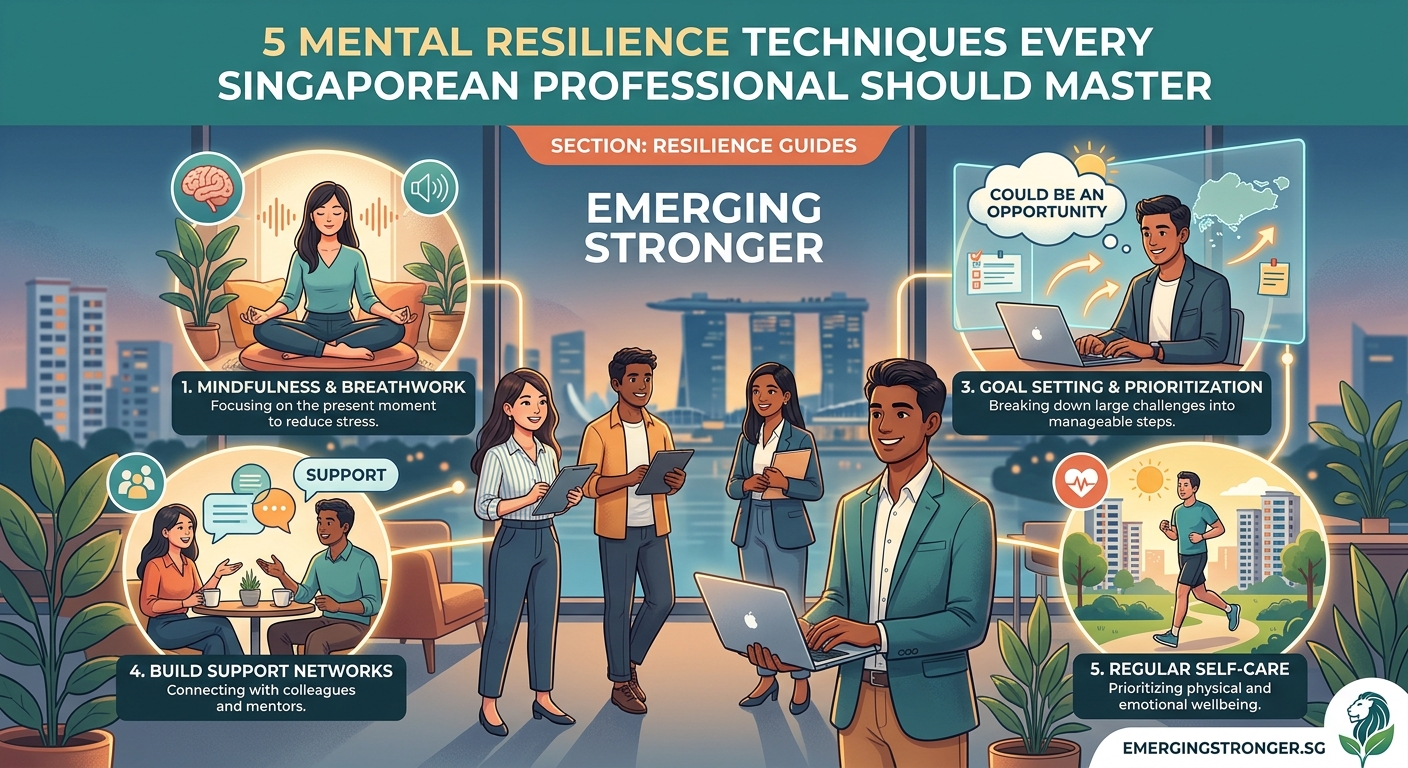
Resilient people aren’t emotionally numb. They’re emotionally literate. There’s a massive difference.
Emotional awareness means recognizing what you’re feeling, understanding why, and choosing how to respond. It’s the opposite of either suppressing emotions or being controlled by them.
Many Singapore professionals learned to compartmentalize early. Feel nothing at work, deal with it later. This works short term but creates long term problems. Suppressed emotions don’t disappear. They accumulate and eventually explode or leak out as chronic stress, irritability, or physical symptoms.
The alternative is building a practice of emotional check-ins. Simple but powerful:
Morning: Before starting work, notice your baseline emotional state. Anxious? Energized? Dreading something specific? Just name it.
Midday: Take two minutes to assess how you’re feeling. If stress is building, acknowledge it. If you’re frustrated, identify the source.
Evening: Review the day’s emotional landscape. What triggered strong reactions? What helped you feel capable or calm?
This isn’t journaling for hours. It’s brief, honest acknowledgment of your internal state. Over time, you’ll notice patterns. Certain situations consistently trigger stress. Certain activities reliably restore your energy. This information becomes strategic.
“The curious paradox is that when I accept myself just as I am, then I can change.” This principle applies to emotions too. When you stop fighting against what you feel and simply observe it, you gain the space to respond thoughtfully instead of reactively.
A project manager I know realized through these check-ins that her stress spiked every time a particular stakeholder sent emails. Not because of the content, but because his communication style reminded her of a previous toxic boss. Once she identified this pattern, she could separate past from present and respond to actual situations instead of old wounds.
Creating recovery practices that actually restore you
Resilience requires recovery. You can’t run at maximum capacity indefinitely without consequences. Yet many professionals treat rest as laziness or weakness.
This mindset guarantees eventual breakdown. Your brain and body need regular restoration to function optimally. Without it, your resilience gradually erodes until even minor setbacks feel overwhelming.
Recovery doesn’t mean doing nothing. It means doing things that genuinely restore your energy rather than just distract you from depletion.
Here’s what actually works:
| Recovery Practice | Why It Works | Common Mistake |
|---|---|---|
| Physical movement | Reduces stress hormones, improves mood regulation | Only exercising when already stressed, making it feel like another obligation |
| Creative activities | Engages different brain regions, provides sense of accomplishment | Choosing activities based on productivity rather than enjoyment |
| Social connection | Activates support systems, provides perspective | Only socializing in professional contexts that maintain work mode |
| Nature exposure | Lowers cortisol, restores attention capacity | Treating outdoor time as rare special events instead of regular practice |
| Deliberate rest | Allows nervous system to reset, consolidates learning | Filling “rest” time with passive scrolling that doesn’t actually restore energy |
The key is building these into your routine before you desperately need them. Waiting until you’re burned out to start recovery practices is like waiting until you’re dehydrated to start drinking water. It works, but prevention is far more effective.
One software developer I know blocks 30 minutes every morning for a walk before work. No phone, no podcasts, just walking. She initially felt guilty about this “unproductive” time. Six months later, she realized she was handling workplace stress far better than colleagues who worked longer hours but never recovered properly.
Learning from failure without letting it define you
Every professional faces failures. Projects that collapse. Promotions you don’t get. Mistakes that cost money or relationships. The difference between people who grow stronger and people who grow bitter lies in how they process these experiences.
Resilient professionals treat failure as information, not identity. When something goes wrong, they ask “What can I learn?” before “What’s wrong with me?”
This distinction matters enormously. If failure means “I’m incompetent,” you’ll avoid risks and opportunities for growth. If failure means “This approach didn’t work in this context,” you’ll experiment and improve.
Here’s a practical framework for learning from setbacks:
- Separate facts from interpretation. What actually happened? Not what it means about you, just the objective events.
- Identify contributing factors. What was within your control? What wasn’t? This isn’t about making excuses but understanding causation accurately.
- Extract specific lessons. What would you do differently? What skills do you need to develop? What assumptions proved incorrect?
- Apply learning forward. How will you test these lessons in future situations? What’s your next experiment?
Notice what’s missing: extensive self-criticism, comparisons to others, catastrophic predictions about your future.
A sales professional I know lost a major deal after months of work. Instead of spiraling into self-doubt, she scheduled a debrief with her manager. They reviewed what went well, what went poorly, and what factors were beyond her control. She identified three specific areas to improve and created a plan to develop those skills. Two months later, she closed an even larger deal using what she’d learned.
This doesn’t mean failure doesn’t hurt. It does. But the pain becomes productive instead of destructive.
Why your resilience practice needs regular maintenance
Mental resilience isn’t something you build once and possess forever. It’s more like physical fitness. Without ongoing practice, it gradually declines.
This reality frustrates people who want permanent solutions. But it’s actually good news. It means you can always rebuild resilience, regardless of how depleted you currently feel.
The practices that build resilience are the same ones that maintain it:
- Regular cognitive reframing keeps your thought patterns flexible
- Ongoing investment in relationships ensures support when you need it
- Consistent emotional awareness prevents small stresses from accumulating
- Built-in recovery practices maintain your baseline capacity
- Continuous learning from experience keeps you adapting and growing
Think of these as your mental resilience routine. Just like you wouldn’t expect to stay physically fit by exercising once and never again, you can’t expect to stay mentally resilient without regular practice.
The good news is that maintenance requires less effort than initial building. Once you’ve established these habits, they become automatic. You’ll naturally reframe negative thoughts, reach out for support, notice your emotions, prioritize recovery, and learn from setbacks.
But you need to protect this practice during stable periods. The biggest mistake professionals make is abandoning resilience practices when things are going well, then scrambling to rebuild them during crisis.
A operations director I know maintains what she calls “resilience appointments” in her calendar. Weekly time for practices that maintain her mental fitness. When colleagues ask how she stays so steady during organizational chaos, this is her answer. She doesn’t wait for crisis to start building resilience. She maintains it constantly.
Building strength that serves you long term
Mental resilience transforms how you experience your professional life. Challenges that would have derailed you become manageable. Setbacks that would have destroyed your confidence become learning opportunities. Stress that would have led to burnout becomes something you can process and recover from.
This doesn’t happen overnight. Building genuine resilience takes consistent practice over months and years. But every small step compounds. Every time you reframe a negative thought, strengthen a relationship, acknowledge an emotion, prioritize recovery, or learn from failure, you’re building capacity that serves you forever.
Start with one practice. Maybe it’s the morning emotional check-in. Maybe it’s reaching out to one person in your support network this week. Maybe it’s scheduling your first real recovery time. Whatever you choose, make it small enough that you’ll actually do it, then build from there.
Your professional life will throw challenges at you. That’s guaranteed. What’s not guaranteed is how those challenges affect you. That part you can influence, one practice at a time.