
You’ve been working in the same field for years. Your boss mentions AI taking over parts of your role. A colleague just switched industries entirely. And you’re stuck wondering: should I get better at what I do, or learn something completely new?
This isn’t just about picking a course. It’s about choosing the right path when your career feels uncertain.
Upskilling deepens your existing expertise, while reskilling pivots you to a new field. Your choice depends on industry viability, personal fulfilment, financial runway, and market demand. This framework helps mid-career professionals in Singapore assess their situation honestly and choose the path that builds genuine resilience, not just credentials.
Understanding the Real Difference Between Upskilling and Reskilling
Most articles treat these terms like they’re interchangeable. They’re not.
Upskilling means getting better at what you already do. A marketing manager learning data analytics. An accountant mastering automation tools. You’re staying in your lane but upgrading your vehicle.
Reskilling means switching lanes entirely. That same accountant becoming a UX designer. The marketing manager retraining as a software developer. You’re learning a fundamentally different craft.
The stakes are different too.
Upskilling usually takes less time and money. You’re building on existing knowledge. Your network still matters. Your past work still counts.
Reskilling often means starting over. Your 15 years of experience might not transfer. You’ll likely earn less initially. You’re competing with people half your age who’ve been in that field longer.
Neither choice is wrong. But picking the right one requires honest assessment, not just following what sounds good on LinkedIn.
Why This Decision Matters More Now Than Ever
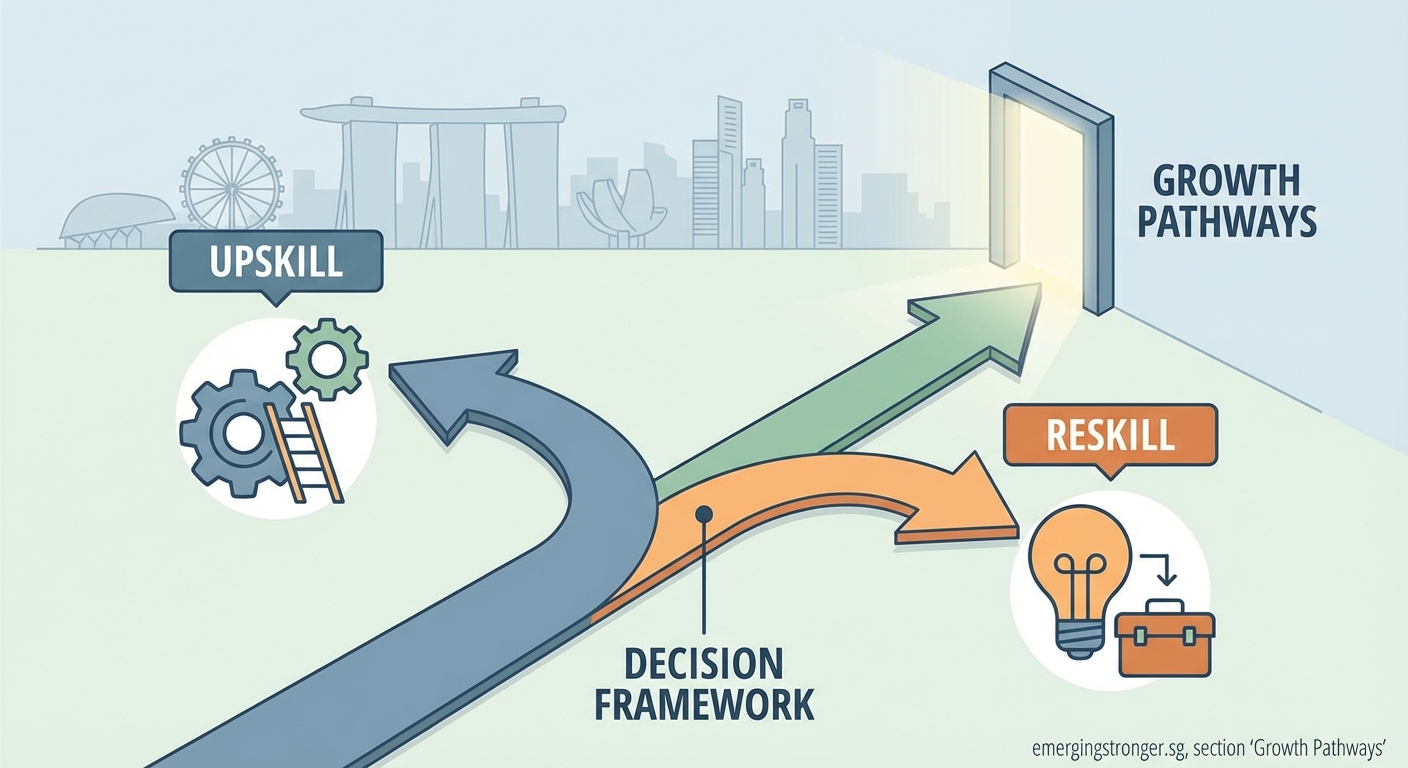
Singapore’s job market is shifting faster than most people realize.
The Skills Framework gets updated constantly. Industries that seemed stable five years ago are automating rapidly. And the government’s push toward skills-first hiring sounds promising, but many companies still hire based on paper qualifications and years of experience.
Here’s what’s actually happening on the ground.
Some sectors are genuinely dying. Others are transforming so fast that upskilling alone won’t save you. And a few are creating entirely new roles that didn’t exist three years ago.
The professionals who bounce back faster aren’t necessarily the smartest or most qualified. They’re the ones who read their situation clearly and act accordingly.
That requires cutting through the noise.
The Four-Factor Assessment Framework
Before you sign up for any course or program, run through these four factors. Be brutally honest with yourself.
Factor 1: Industry Viability
Is your current industry actually viable for the next 10 years?
Not what government reports say. Not what your company claims. What do the actual hiring trends show?
Check job boards weekly. See if roles like yours are increasing or decreasing. Notice if the requirements are changing. Pay attention to salary trends.
If your industry is contracting or automating rapidly, upskilling might just be polishing a sinking ship. You’ll get better at something the market wants less of.
Factor 2: Personal Fulfilment vs Practical Reality
Do you still like what you do?
This matters more than people admit. If you’ve spent 15 years in finance but secretly hate it, upskilling in fintech won’t solve your problem. You’ll just be miserable with better tools.
But here’s the hard part: fulfilment alone doesn’t pay bills.
Reskilling into something you love sounds romantic. But if that field pays 40% less and you’ve got a mortgage and kids in school, the stress will eat you alive.
The sweet spot is finding something you can tolerate that also makes financial sense. Perfect passion is rare. Sustainable satisfaction is achievable.
Factor 3: Financial Runway
How long can you afford to invest in learning before you need income?
Upskilling usually lets you keep working while learning. Evening courses. Weekend bootcamps. On-the-job training. You maintain income while building skills.
Reskilling often requires full-time commitment. Especially if you’re switching to technical fields. You might need 6 to 12 months of intensive learning before you’re hireable.
Can your savings handle that? Will your family support it? What’s your backup plan if it takes longer than expected?
Building a six-month emergency fund isn’t just about job loss. It’s about creating the runway for strategic career moves.
Factor 4: Market Demand Reality Check
What does the market actually want right now?
Not what training providers advertise. Not what sounds trendy. What are companies actively hiring for?
Look at job postings. Talk to recruiters. Join industry groups and listen to what people complain about. Skills gaps are opportunities, but only if you can fill them before the market shifts again.
Some fields have genuine shortages. Others are oversaturated with fresh graduates and career switchers. Entering an oversaturated field means competing on price, which usually means lower pay and worse conditions.
A Practical Decision Matrix
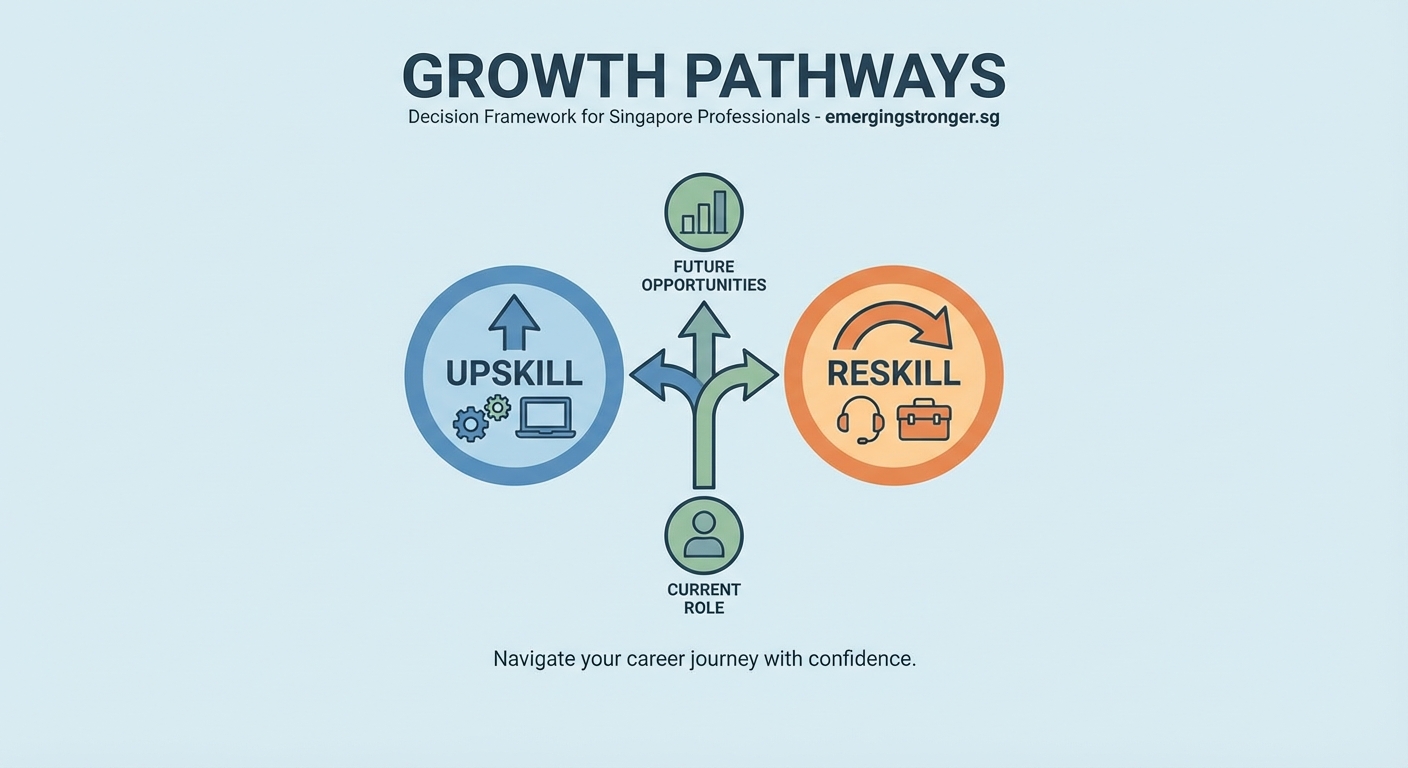
Here’s a simple table to clarify your thinking:
| Scenario | Your Industry Status | Your Interest Level | Recommended Path |
|---|---|---|---|
| Stable sector, high interest | Growing or steady | You enjoy the work | Upskill strategically |
| Declining sector, high interest | Shrinking rapidly | You love what you do | Reskill to adjacent field |
| Stable sector, low interest | Growing or steady | You’re burnt out | Consider lateral reskill |
| Declining sector, low interest | Shrinking rapidly | You’re miserable | Reskill to growth sector |
| Uncertain sector, high interest | Mixed signals | You’re engaged | Upskill while monitoring |
| Uncertain sector, low interest | Mixed signals | You’re disconnected | Assess before committing |
This isn’t absolute. Your personal circumstances matter. But it gives you a starting framework.
Common Mistakes Singapore Professionals Make
Most people make one of these errors when facing the upskilling vs reskilling decision.
Mistake 1: Following trends instead of demand
Just because everyone’s talking about AI doesn’t mean you should become a data scientist. The market might already be flooded with people who made that jump two years ago.
Mistake 2: Underestimating the emotional cost of starting over
Reskilling means being the junior again. It means not knowing the unwritten rules. It means younger colleagues explaining basics to you. If you’re not prepared for that psychologically, it’ll break you.
Mistake 3: Overestimating how much upskilling will change your situation
Adding one more certification to your resume won’t save you if your entire role is being automated. Sometimes the problem isn’t your skills. It’s the chair you’re sitting in.
Mistake 4: Waiting for perfect clarity
You’ll never have complete information. At some point, you need to make a call based on the best data you have. Waiting too long is itself a decision, and usually not a good one.
The Three-Step Decision Process
Here’s how to actually make this choice:
1. Audit your current position honestly
Write down exactly where you stand.
Your current skills. Your industry’s trajectory. Your financial situation. Your family obligations. Your energy levels. Your genuine interests.
Don’t sugarcoat it. This is for you, not your LinkedIn profile.
2. Research three potential paths
Don’t just pick one option and convince yourself it’s right.
Map out three realistic scenarios:
- Path A: Upskill in your current field
- Path B: Reskill to an adjacent field
- Path C: Reskill to a completely different field
For each path, identify:
- Specific skills you’d need to learn
- Time required to become hireable
- Realistic salary expectations
- Available support programs in Singapore
- Actual job availability
3. Test before you commit fully
Before you quit your job or spend $20,000 on a bootcamp, test the waters.
Take a short introductory course. Do freelance projects. Talk to people actually working in that field. See if you still like it after the novelty wears off.
Many people romanticize career changes until they actually try the work. Testing saves you from expensive mistakes.
Leveraging Singapore’s Support Ecosystem
Singapore actually offers substantial support for both upskilling and reskilling. Most people just don’t know how to access it properly.
SkillsFuture credits are the obvious starting point. But the real value is in sector-specific programs.
Workforce Singapore runs career conversion programs that combine training with job placement. These work well if you’re reskilling into sectors with genuine shortages.
The Career Trial program lets you test a new role for up to three months while getting paid. It’s basically a long interview that reduces risk for both you and the employer.
Union training programs often provide industry-specific upskilling at subsidised rates. If you’re staying in your field, these can be more practical than generic courses.
Professional associations sometimes offer mentorship and networking that matter more than formal qualifications. Especially in fields where relationships drive opportunities.
“The best career move I made wasn’t picking the right course. It was joining an industry association and actually showing up to events. That’s where I learned what skills actually mattered and met the person who hired me.” – Former banker who reskilled into sustainability consulting
What Success Actually Looks Like
Here’s what matters more than certificates or course completion rates.
For upskilling success:
- You’re solving problems at work that you couldn’t solve before
- Your manager gives you different types of projects
- Recruiters contact you about roles you’d actually want
- Your salary reflects your expanded capabilities
For reskilling success:
- You can explain your transferable skills without sounding desperate
- You’ve built a small portfolio of work in your new field
- You’ve connected with people who can vouch for your abilities
- You’ve accepted that starting salary might be lower but see a clear growth path
Success isn’t about the decision itself. It’s about executing whichever path you choose with commitment and realism.
When to Reconsider Your Choice
Sometimes you pick a path and realize it’s wrong. That’s not failure. That’s information.
Signs you should reconsider upskilling:
- Your industry keeps shrinking despite your new skills
- The skills you’re learning are becoming automated too
- You’re getting better at something you genuinely hate
- The market isn’t rewarding your improvements
Signs you should reconsider reskilling:
- You’re six months in and still miserable
- The financial strain is destroying your mental health
- You miss your old field more than you expected
- The new industry isn’t what you thought it would be
Changing direction isn’t giving up. It’s responding to new information and adjusting accordingly.
Building Resilience Regardless of Your Choice
Whether you upskill or reskill, you need resilience to handle the uncertainty.
Career transitions are stressful. You’ll doubt yourself. You’ll compare yourself to others. You’ll wonder if you made the right call.
Mental resilience techniques aren’t soft skills. They’re survival tools for navigating career uncertainty without falling apart.
The professionals who thrive through transitions aren’t the ones with the best credentials. They’re the ones who can handle setback, maintain perspective, and keep moving forward even when progress feels slow.
That resilience matters more than any technical skill you’ll learn.
Making Peace with Imperfect Information
Here’s the truth nobody wants to hear: you can’t know for certain if you’re making the right choice.
Industries shift. Technologies change. Personal circumstances evolve. What looks like a smart move today might seem foolish in three years, through no fault of your own.
That’s not a reason to freeze. It’s a reason to choose based on the best information you have right now, commit to that choice fully, and stay flexible enough to adjust if needed.
The goal isn’t to make a perfect decision. It’s to make a reasonable decision and then make it work through effort and adaptation.
Some people upskill successfully and thrive. Others reskill and find careers they love. And some do both over the course of their working lives.
The framework matters less than your willingness to assess honestly, choose deliberately, and execute consistently.
Your career isn’t a straight line. It’s a series of decisions made with incomplete information, adjusted as you learn more about yourself and the market.
That’s not a weakness. That’s how careers actually work.
Your Next Move Starts with One Honest Conversation
Stop scrolling through course catalogues for a moment.
Sit down with someone who knows your situation well. Not someone who’ll just encourage you. Someone who’ll ask hard questions.
Talk through the four factors. Map out your three paths. Identify your actual constraints, not the ones you wish you had.
Then pick the path that makes the most sense given where you actually are, not where you wish you were.
You don’t need perfect clarity. You need enough information to take the next step, and the resilience to handle whatever comes after.
The choice between upskilling and reskilling isn’t about picking the objectively correct answer. It’s about understanding yourself and the market well enough to make a decision you can commit to.
That commitment, more than the decision itself, is what determines whether you emerge stronger.