
You’re sitting at your desk at 11pm for the third night this week, staring at your laptop screen without actually seeing the words. Your inbox has 247 unread emails. Your team needs answers. Your family needs you. But you feel completely empty, running on fumes, wondering when work stopped feeling meaningful and started feeling like a treadmill you can’t get off.
Burnout doesn’t mean you’ve failed. It’s a signal that your current approach needs recalibration. This guide helps you recognise the physical, emotional, and cognitive warning signs of burnout, then provides a structured reset framework to move from exhaustion to breakthrough. You’ll learn practical recovery strategies, boundary-setting techniques, and resilience-building practices tailored for Singapore’s high-pressure work environment.
Understanding what burnout actually means
Burnout isn’t just feeling tired after a long week.
It’s a state of chronic physical and emotional exhaustion caused by prolonged stress. The World Health Organization classifies it as an occupational phenomenon characterised by three dimensions: energy depletion, increased mental distance from your job, and reduced professional efficacy.
In Singapore’s achievement-oriented culture, burnout often gets misread as a personal weakness. Leaders especially feel pressure to push through, believing that admitting exhaustion means admitting defeat.
That’s backwards thinking.
Burnout is your body’s alarm system telling you that something fundamental needs to change. Ignoring it doesn’t make you stronger. It makes the eventual crash harder.
The journey from burnout to breakthrough starts with honest recognition. You can’t fix what you won’t acknowledge.
Warning signs you’re heading towards burnout
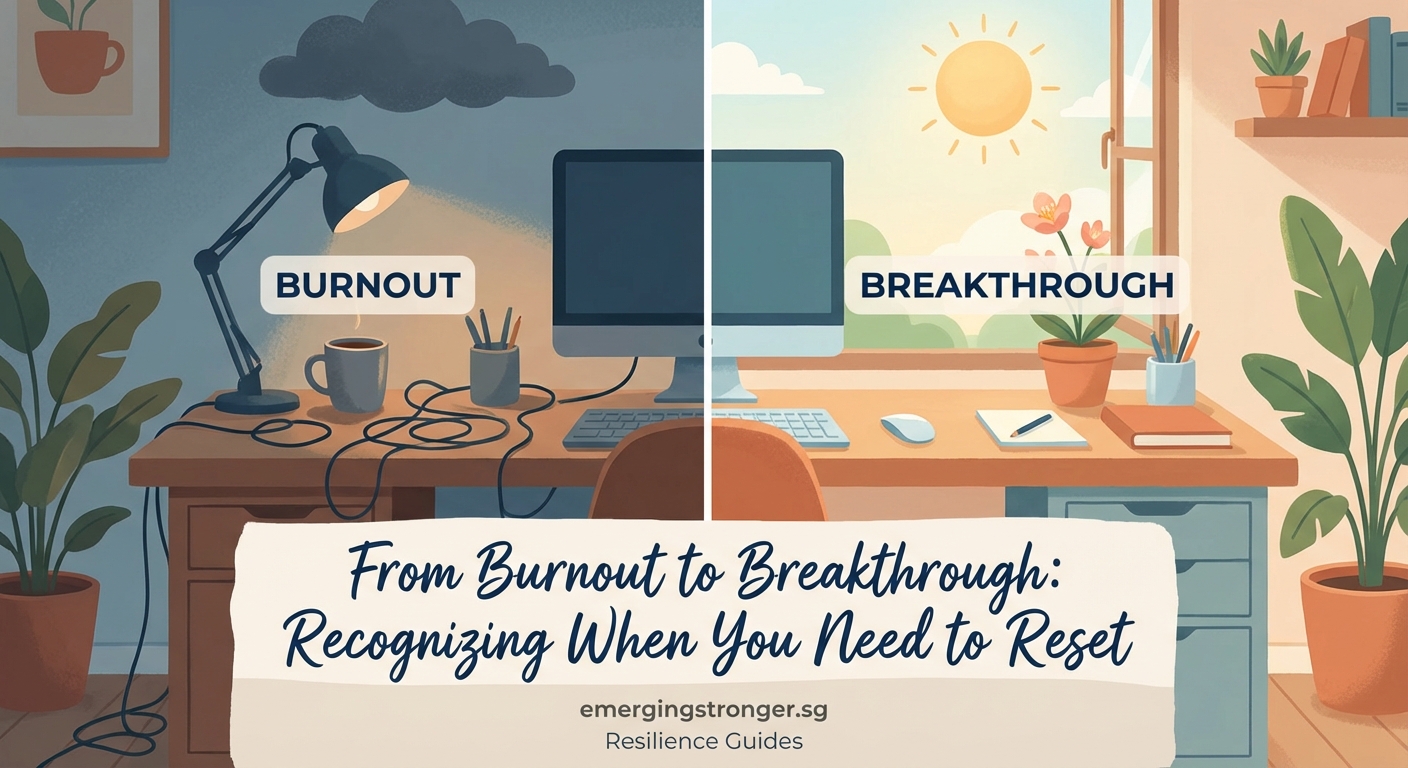
Your body and mind send signals long before you hit complete exhaustion. Most professionals miss these early warnings because they’re too busy to notice, or they’ve normalised dysfunction.
Physical symptoms that demand attention
- Persistent fatigue that doesn’t improve with rest
- Frequent headaches or muscle tension, especially in neck and shoulders
- Changes in appetite or sleep patterns
- Getting sick more often as your immune system weakens
- Digestive issues that appear without clear medical cause
Emotional and mental red flags
- Feeling cynical or detached from work that once excited you
- Irritability with colleagues, clients, or family members
- Sense of dread about going to work each morning
- Difficulty concentrating or making decisions
- Feeling like nothing you do makes a real difference
Behavioural changes others might notice first
Sometimes your team or family spots the shifts before you do. You might start withdrawing from social interactions, missing deadlines that were once easy to meet, or relying on caffeine and sugar to get through the day.
One senior manager in a Singaporean tech firm described it perfectly: “I realised I was burned out when I stopped caring about projects I’d championed for months. I’d sit in meetings physically present but mentally checked out, just nodding along.”
The reset framework: four stages from exhaustion to energy
Moving from burnout to breakthrough isn’t about working harder or finding more willpower. It requires a systematic reset that addresses root causes, not just symptoms.
Stage 1: Create immediate space
You can’t think clearly when you’re drowning. The first priority is creating breathing room.
-
Identify three tasks you can delegate, postpone, or eliminate this week. Not eventually. This week. Write them down and take action today.
-
Block out two hours of protected time in the next 48 hours. No meetings, no emails, no exceptions. Use this time to rest, not to catch up on work.
-
Have one honest conversation with your manager or a trusted colleague. You don’t need to share everything, but you need to start acknowledging reality out loud.
This stage feels uncomfortable because high achievers hate stepping back. Do it anyway. You’re not abandoning responsibility. You’re preventing total collapse.
Stage 2: Assess what’s actually draining you
Not all stress is equal. Some pressures energise you. Others deplete you completely.
Create a simple energy audit using this table:
| Activity | Energy Impact | Can I Change It? | Action |
|---|---|---|---|
| Weekly status meetings | Draining | Yes | Suggest bi-weekly format |
| Client presentations | Energising | No change needed | Keep as is |
| Late-night emails | Severely draining | Yes | Set 8pm email boundary |
| Mentoring junior staff | Energising | No change needed | Protect this time |
| Administrative paperwork | Draining | Partially | Delegate where possible |
This exercise reveals patterns. You might discover that 80% of your exhaustion comes from 20% of your activities. That’s actionable intelligence.
Many Singapore professionals find that cultural expectations around responsiveness create invisible drains. The assumption that you should reply to messages within minutes, even after hours, adds constant low-level stress that accumulates into burnout.
Stage 3: Rebuild boundaries and priorities
Boundaries aren’t walls. They’re guidelines that protect your capacity to perform sustainably.
“The most productive leaders I work with aren’t the ones who say yes to everything. They’re the ones who protect their energy fiercely so they can give their best to what truly matters.” – Executive coach specialising in leadership resilience
Start with these non-negotiable boundaries:
- Time boundaries: Define when your workday ends. Communicate this clearly. Stick to it except for genuine emergencies.
- Communication boundaries: You don’t need to be available on every platform. Choose two primary channels and set expectations about response times.
- Energy boundaries: Learn to recognise when you’re operating in deficit. Give yourself permission to say “I need to step back and recharge before I can give this proper attention.”
Rebuilding priorities means getting ruthless about what deserves your limited energy. Ask yourself: “If I could only accomplish three things this quarter, what would create the most meaningful impact?”
Everything else becomes secondary or gets delegated.
Stage 4: Build sustainable recovery practices
Recovery isn’t a one-time event. It’s an ongoing practice woven into your daily routine.
The professionals who successfully move from burnout to breakthrough don’t just rest once and return to old patterns. They fundamentally restructure how they work.
Daily micro-recoveries:
– Five minutes of evidence-based breathing techniques between meetings
– A proper lunch break away from your desk
– A short walk before your first meeting of the day
Weekly reset rituals:
– One completely work-free day where you don’t check email
– A physical activity that gets you out of your head
– Time with people who energise rather than drain you
Monthly reflection:
– Review your energy audit and adjust boundaries as needed
– Celebrate progress, even small wins
– Identify emerging patterns before they become problems
These practices might seem basic. That’s the point. Breakthrough doesn’t come from complex solutions. It comes from consistent application of fundamentals you’ve been neglecting.
Common mistakes that prevent breakthrough
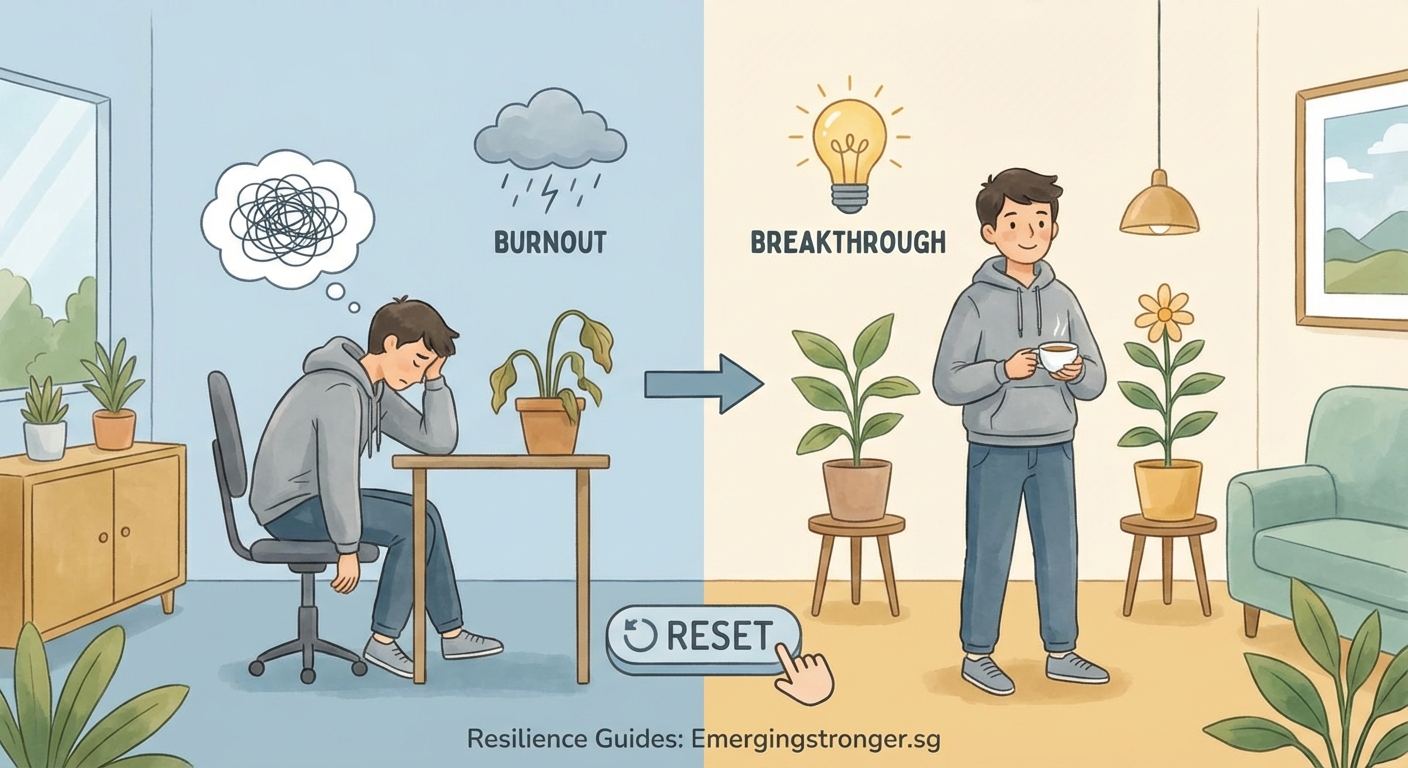
Even with the best intentions, certain patterns sabotage recovery.
Mistake 1: Treating symptoms instead of causes
Taking a holiday feels good temporarily. But if you return to the same toxic patterns, you’ll burn out again within weeks. Real recovery requires structural change, not just temporary relief.
Mistake 2: Believing you can power through alone
The same mindset that drove you to burnout won’t get you out of it. You need external support, whether that’s a mentor, therapist, coach, or trusted peer group. Consider exploring free mental health services available in Singapore if you need professional guidance.
Mistake 3: Setting unrealistic recovery timelines
If you’ve been burning out for two years, you won’t fully recover in two weeks. Give yourself permission to heal at a sustainable pace. Progress isn’t linear.
Mistake 4: Neglecting the role of meaning
Sometimes burnout signals that your work has lost connection to your deeper values. Recovery might require not just rest, but realignment with what actually matters to you. This connects to building a personal growth plan that works in Singapore’s environment.
Building resilience for the long term
Moving from burnout to breakthrough isn’t just about recovery. It’s about building capacity to handle future pressures without breaking.
Resilience isn’t about being tough enough to endure anything. It’s about developing flexibility, self-awareness, and support systems that help you adapt to challenges without depleting yourself completely.
The science behind why some people bounce back faster reveals that resilience is a learnable skill, not a fixed personality trait. You can develop it through deliberate practice.
Key resilience practices include:
- Cultivating self-awareness: Regular check-ins with yourself about your energy levels, emotional state, and stress signals
- Building strong support networks: Relationships with people who can offer perspective, encouragement, and practical help
- Maintaining physical foundations: Sleep, nutrition, and movement aren’t luxuries. They’re the infrastructure that everything else depends on
- Developing mental resilience techniques specific to your context: What works in theory might need adaptation for Singapore’s unique pressures
Consider engaging with a structured resilience challenge to build these capabilities systematically.
When professional help makes the difference
Some situations require more than self-directed recovery. Professional support isn’t a sign of weakness. It’s strategic resource allocation.
Consider seeking professional help if:
- You’ve tried recovery strategies for several months without meaningful improvement
- Burnout is affecting your physical health in concerning ways
- You’re experiencing symptoms of depression or anxiety alongside burnout
- Your relationships are suffering significantly
- You’re having thoughts of harming yourself
Singapore offers various professional resources, from workplace Employee Assistance Programmes to private therapists specialising in occupational stress.
The investment in professional support often prevents far more costly consequences down the line, both personally and professionally.
Financial stability supports emotional recovery
Money stress and burnout often intersect. When you’re exhausted, financial worries compound the pressure. When you’re financially stressed, work burnout intensifies.
Building a six-month emergency fund creates psychological safety that makes it easier to set boundaries and make necessary changes. You can’t easily walk away from toxic situations or take needed recovery time if you’re living paycheque to paycheque.
Financial resilience and emotional resilience support each other. Working on both simultaneously creates a stronger foundation for breakthrough.
Real stories of transformation
Theory matters less than proof. Real people in Singapore have moved from severe burnout to meaningful breakthrough.
A 38-year-old marketing director described her turning point: “I ended up in the emergency room with chest pains that turned out to be a panic attack. That was my wake-up call. I took two weeks of medical leave, worked with a therapist, and completely restructured my work boundaries. Six months later, I’m doing better work with half the stress.”
Another professional found inspiration in stories of career reinvention, which helped her realise that breakthrough sometimes means changing direction entirely, not just recovering in place.
These transformations share common elements: honest acknowledgment of the problem, willingness to make uncomfortable changes, support from others, and patience with the recovery process.
Your breakthrough won’t look identical to anyone else’s. But the fundamental principles apply universally.
Turning exhaustion into your greatest teacher
Burnout feels like failure. But it can become the catalyst for building a more sustainable, meaningful approach to work and life.
The professionals who emerge strongest from burnout are those who treat it as valuable feedback rather than shameful weakness. They ask: “What is this experience teaching me about my limits, my values, and what actually matters?”
That shift in perspective transforms burnout from a dead end into a breakthrough moment.
You’re not broken. You’re not weak. You’re human, operating in systems that often demand more than humans can sustainably give. Recognising that truth is the first step. Taking action to reset is the second.
The path from burnout to breakthrough isn’t easy. But it’s absolutely possible. And it starts with the decision to prioritise your wellbeing as seriously as you’ve prioritised everything else.
Your breakthrough is waiting on the other side of the reset you’ve been avoiding. Take the first step today.