
You just lost your job. The retrenchment email hits your inbox at 4pm on a Tuesday. Your hands shake as you open your banking app. S$800 left until next month’s rent is due.
This nightmare scenario plays out more often than we talk about. But here’s the truth: an emergency fund isn’t just about money. It’s about sleeping soundly when the economy wobbles. It’s about having options when life throws curveballs. And yes, you can build one even if your salary feels tight right now.
Building a 6-month emergency fund in Singapore requires calculating your essential monthly expenses, opening a dedicated high-yield savings account, and automating transfers of 10-20% of your income. Start with a S$1,000 starter fund, then scale up. Use the 50/30/20 budget rule, redirect windfalls, and protect your fund from non-emergency spending. Every salary level can build financial resilience through consistent, strategic saving habits.
Why Singapore workers need emergency funds more than ever
The cost of living keeps climbing. HDB resale prices hit record highs. Hawker meals that cost S$3 now push S$5. Your parents’ generation could survive on CPF alone. That playbook doesn’t work anymore.
An emergency fund creates breathing room. It covers you when the aircon compressor dies in the middle of June. It pays bills when you’re between jobs. It prevents you from maxing out credit cards at 26% interest just to survive.
Think of it as insurance you control. No claims process. No waiting period. Just cash ready when crisis strikes.
What counts as a real emergency
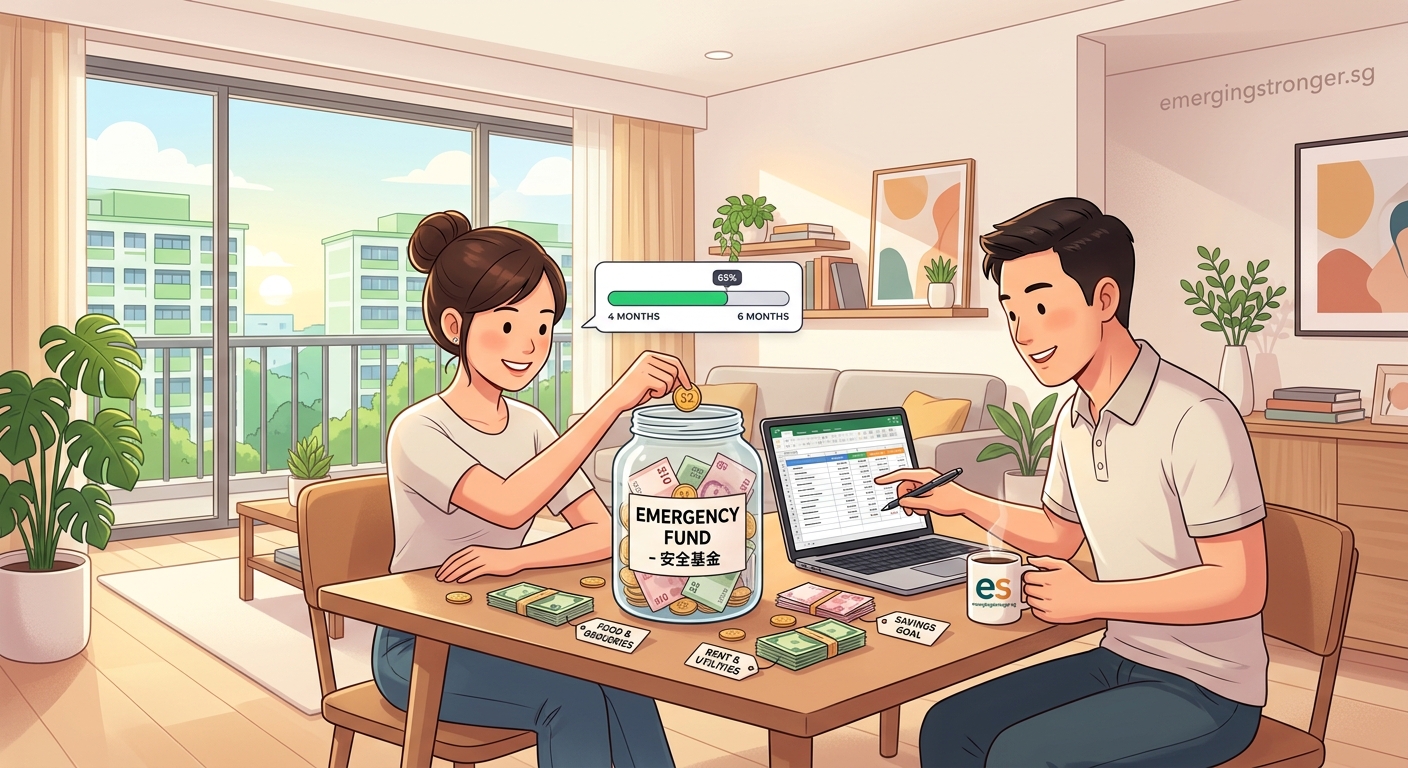
Not every expense deserves emergency fund money. Here’s the test: Is it unexpected, necessary, and urgent?
Genuine emergencies:
– Medical bills not covered by insurance
– Sudden job loss or income reduction
– Critical home repairs (burst pipes, electrical faults)
– Urgent family support needs
– Essential car repairs for work commute
Not emergencies:
– Holiday sales on electronics
– Wedding angpow season
– Your friend’s destination birthday trip
– Upgrading your phone
– Annual insurance premiums you knew were coming
The difference matters. Treat your emergency fund like a fire extinguisher. You don’t use it to cook dinner. You use it when something’s actually burning.
How much you actually need to save
The standard advice says six months of expenses. But that’s too vague for real planning.
Start by calculating your essential monthly costs. Not what you spend. What you absolutely need to survive.
Essential expenses only:
– Rent or mortgage
– Utilities (electricity, water, internet)
– Groceries and basic meals
– Transport to work
– Insurance premiums
– Minimum debt payments
– Phone bill
Skip Netflix. Skip gym memberships. Skip your weekly bubble tea runs. We’re talking survival mode, not comfort mode.
Let’s say your essentials total S$2,200 per month. Your six-month target becomes S$13,200. That’s your number. Write it down. Make it real.
Your step-by-step savings blueprint
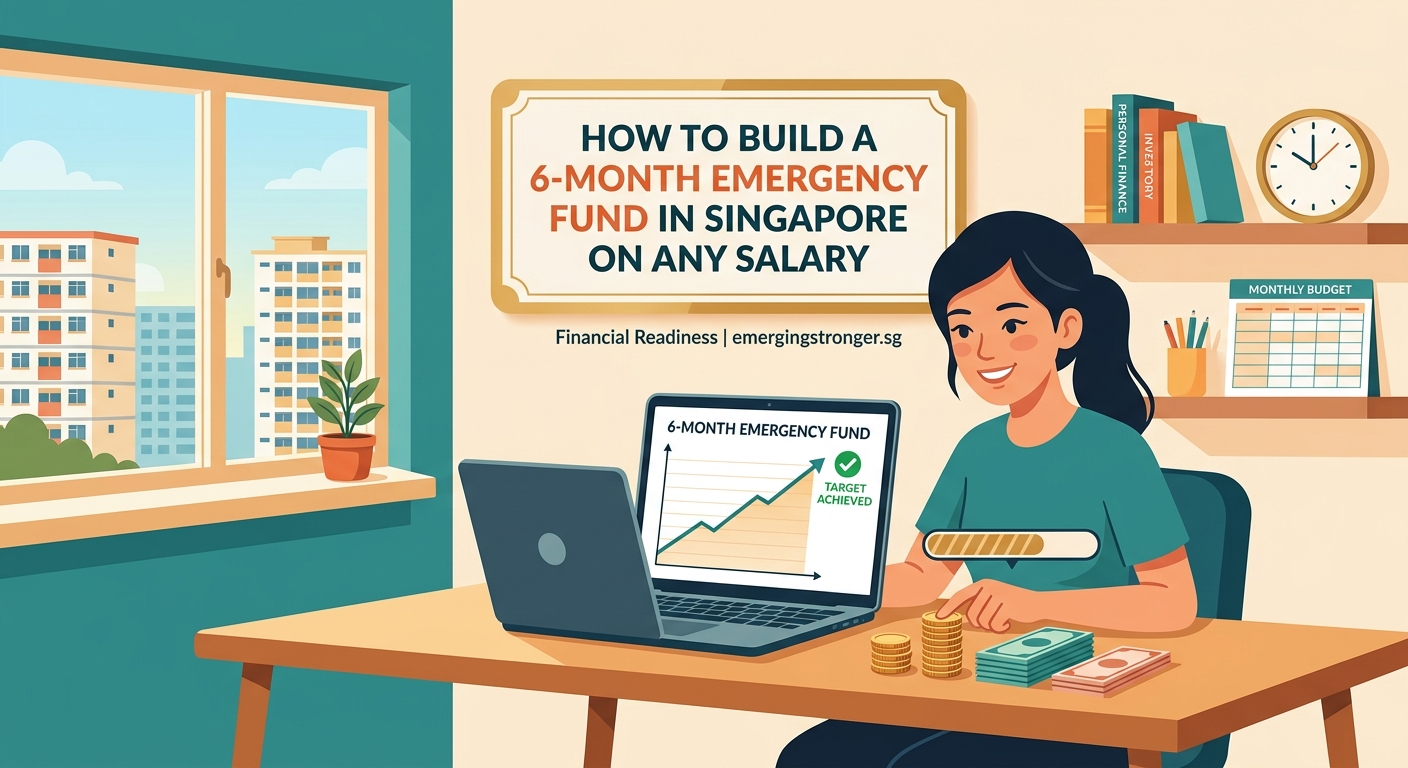
Building an emergency fund isn’t magic. It’s a system. Here’s exactly how to do it.
1. Open a dedicated savings account
Don’t mix emergency money with spending money. The temptation is too strong.
Look for high-yield savings accounts. Several Singapore banks offer 2-4% interest on the first S$50,000 to S$100,000. That’s free money for doing nothing.
Name the account something specific. “Emergency Fund” or “Job Loss Safety Net.” Seeing the purpose every time you log in reinforces the habit.
2. Start with a S$1,000 starter fund
Six months of expenses feels impossible when you’re starting from zero. So don’t start there.
Your first milestone is S$1,000. This covers most small emergencies without derailing your entire plan. A minor medical bill. An urgent laptop repair for work. A last-minute flight home.
This smaller target builds momentum. You’ll hit it faster than you think. That early win keeps you motivated for the bigger goal.
3. Automate everything
Willpower fails. Systems work.
Set up an automatic transfer on payday. The money moves to your emergency fund before you see it. Before you can spend it on late-night food delivery.
Start with 10% of your income. If that feels too tight, start with 5%. The percentage matters less than the consistency.
4. Apply the 50/30/20 budget framework
This simple rule keeps your finances balanced:
– 50% for needs (rent, food, transport)
– 30% for wants (entertainment, hobbies, dining out)
– 20% for savings and debt repayment
Your emergency fund comes from that 20%. If you’re paying off high-interest debt, split it: 10% to debt, 10% to emergency savings. Once you hit your S$1,000 starter fund, you can shift more toward debt payoff.
5. Capture every windfall
Bonuses. Tax refunds. Ang pows during Chinese New Year. That surprise client payment.
Redirect 50-75% of unexpected money straight to your emergency fund. You weren’t counting on it anyway. You won’t miss what you never budgeted for.
This accelerates your timeline dramatically. A S$3,000 bonus could knock out three months of saving in one transfer.
6. Review and adjust monthly
Life changes. Your emergency fund target should too.
Got a promotion? Increase your automatic transfer. Moved to a cheaper flat? Lower your target amount. Had a baby? Raise your target to cover new expenses.
Block 15 minutes on the first Sunday of each month. Check your progress. Adjust your plan. Stay connected to the goal.
Common mistakes that drain emergency funds
| Mistake | Why it hurts | Better approach |
|---|---|---|
| Using it for planned expenses | Depletes the fund for non-emergencies | Create separate sinking funds for annual costs |
| Keeping it in a current account | Earns zero interest, loses to inflation | Use high-yield savings with easy access |
| Setting an unrealistic target | Creates discouragement, leads to quitting | Start small, build gradually |
| No clear definition of “emergency” | Leads to frequent withdrawals | Write down your emergency criteria |
| Stopping after the first goal | Inflation erodes purchasing power | Review and top up annually |
What to do when your salary feels too small
“I barely survive month to month. How can I save?”
Fair question. Here’s the honest answer: you find money by making money or cutting costs. Sometimes both.
On the earning side:
– Take on freelance work in your field
– Sell items you no longer use on Carousell
– Offer tutoring if you have expertise
– Drive for Grab during off-peak hours
– Monetise a skill (design, writing, coding)
On the spending side:
– Cook meals instead of eating out (saves S$200-400 monthly)
– Switch to a cheaper phone plan
– Cancel subscriptions you rarely use
– Buy groceries at wet markets instead of supermarkets
– Walk or cycle short distances instead of taking Grab
Even S$50 a month adds up. That’s S$600 in a year. In two years, you’re at S$1,200 plus interest. You’ve exceeded your starter fund goal.
The mental shift matters more than the amount. You’re building financial resilience, not just saving money. That mindset change affects every decision you make.
Where to actually keep your emergency money
Accessibility beats returns for emergency funds. You need the cash within 24-48 hours when crisis hits.
Good options in Singapore:
– High-yield savings accounts (2-4% interest, instant access)
– Singapore Savings Bonds (slightly higher returns, one-month redemption)
– Money market funds (competitive rates, T+1 or T+2 withdrawal)
Bad options:
– Fixed deposits (penalties for early withdrawal)
– Stocks or ETFs (market volatility risk)
– Cryptocurrency (extreme volatility, liquidity issues)
– Your CPF Ordinary Account (can’t withdraw for emergencies)
Keep it boring. Keep it liquid. Keep it safe.
How emergency funds connect to overall resilience
Money is just one piece of bouncing back from setbacks. Financial stability supports mental and emotional strength.
When you know you can cover three to six months of expenses, stress decreases. You make better decisions at work because you’re not desperate to keep a toxic job. You can take calculated career risks because you have a safety net.
This financial foundation pairs well with mental resilience techniques every Singaporean professional should master. Money can’t solve everything, but it removes one major source of anxiety.
If you’re facing retrenchment or career uncertainty, having an emergency fund gives you options. You can be strategic about your next move instead of grabbing the first offer out of panic. Stories like how a 42-year-old banker found her second career in Singapore show how financial preparation creates space for meaningful career transitions.
Real numbers from real salaries
Let’s make this concrete with three scenarios.
Scenario A: Fresh graduate earning S$3,000/month
– Essential expenses: S$1,800
– 6-month target: S$10,800
– Monthly savings (15%): S$450
– Time to full fund: 24 months
– With S$2,000 annual bonus: 20 months
Scenario B: Mid-career professional earning S$5,500/month
– Essential expenses: S$3,200
– 6-month target: S$19,200
– Monthly savings (20%): S$1,100
– Time to full fund: 17.5 months
– With S$5,000 annual bonus: 14 months
Scenario C: Single parent earning S$4,200/month
– Essential expenses: S$2,900
– 6-month target: S$17,400
– Monthly savings (10%): S$420
– Time to full fund: 41 months
– With S$1,500 annual bonus: 37 months
Notice the pattern. Higher earners finish faster, but everyone can build a fund with consistency.
When you need to use your emergency fund
You’ve built your safety net. Now what?
“An emergency fund is permission to breathe during chaos. Use it without guilt when genuine crisis strikes. That’s exactly why you built it.” – Financial counsellor at Credit Counselling Singapore
Replace what you withdraw as soon as possible. Pause other savings goals temporarily if needed. Get your emergency fund back to full strength before resuming investments or discretionary spending.
Track every withdrawal. Write down the reason. This creates accountability and helps you spot patterns. If you’re dipping into emergency funds monthly, you have a budget problem, not an emergency problem.
How to protect your fund from yourself
The biggest threat to your emergency fund isn’t the economy. It’s you.
Protection strategies:
– Keep it in a different bank from your daily accounts
– Don’t link it to your debit card
– Remove it from your banking app home screen
– Set up withdrawal alerts
– Tell an accountability partner about your fund
Make accessing the money slightly inconvenient. Not impossible, but not effortless either. This friction stops impulse withdrawals.
When financial stress hits hard and you’re tempted to raid your emergency fund for non-emergencies, consider free mental health services in Singapore you can access today. Sometimes the real emergency is getting support before money problems spiral.
Building financial security on any income
You don’t need a high salary to build an emergency fund. You need a system, consistency, and patience.
Start today with whatever you can afford. S$20. S$50. S$100. The amount matters less than starting.
Open that dedicated account this week. Set up the automatic transfer. Calculate your target number. Break it into milestones.
Your future self, standing strong through the next crisis, will thank you for the foundation you’re building right now. Financial resilience isn’t about never facing hardship. It’s about having the resources to weather storms without breaking.
And that’s something worth saving for.

