
Losing your job feels like the ground shifting beneath your feet. One moment you’re planning your next quarterly target, the next you’re holding a retrenchment letter and wondering how to pay next month’s bills. If you’ve just been retrenched or you’re worried it might happen soon, you’re not alone. Thousands of Singaporeans face this every year, and the good news is that retrenchment support Singapore offers is more comprehensive than most people realize.
Singapore provides multiple retrenchment support programs including career coaching, skills training subsidies, job matching services, and financial assistance. Government agencies like Workforce Singapore and e2i offer free resources to help you transition. Understanding your retrenchment benefits, accessing immediate financial relief, and using reskilling programs can significantly shorten your job search and help you emerge stronger from this setback.
Understanding your retrenchment package and immediate rights
Before you do anything else, read your retrenchment letter carefully. Your employer must provide written notice, and the terms matter more than you think.
Most companies offer retrenchment benefits based on your length of service. The typical formula ranges from two weeks to one month’s salary per year of service. If you’ve worked for five years, that could mean anywhere from 10 weeks to five months of salary as a lump sum.
Not all employers are legally required to pay retrenchment benefits, but many do based on industry practice or employment contracts. Check your contract and company handbook. If your company has ten or more employees, they must notify the Ministry of Manpower about your retrenchment, which triggers access to government support services.
Your notice period also affects your timeline. Some employers pay in lieu of notice, giving you immediate freedom to job hunt. Others may ask you to serve out your notice or place you on garden leave. Each scenario changes your financial runway differently.
“The first 48 hours after receiving your retrenchment notice are crucial. Don’t make emotional decisions, but do start documenting everything and understanding what you’re entitled to.” – Career transition specialist at Workforce Singapore
Government programs that provide immediate retrenchment support Singapore residents can access
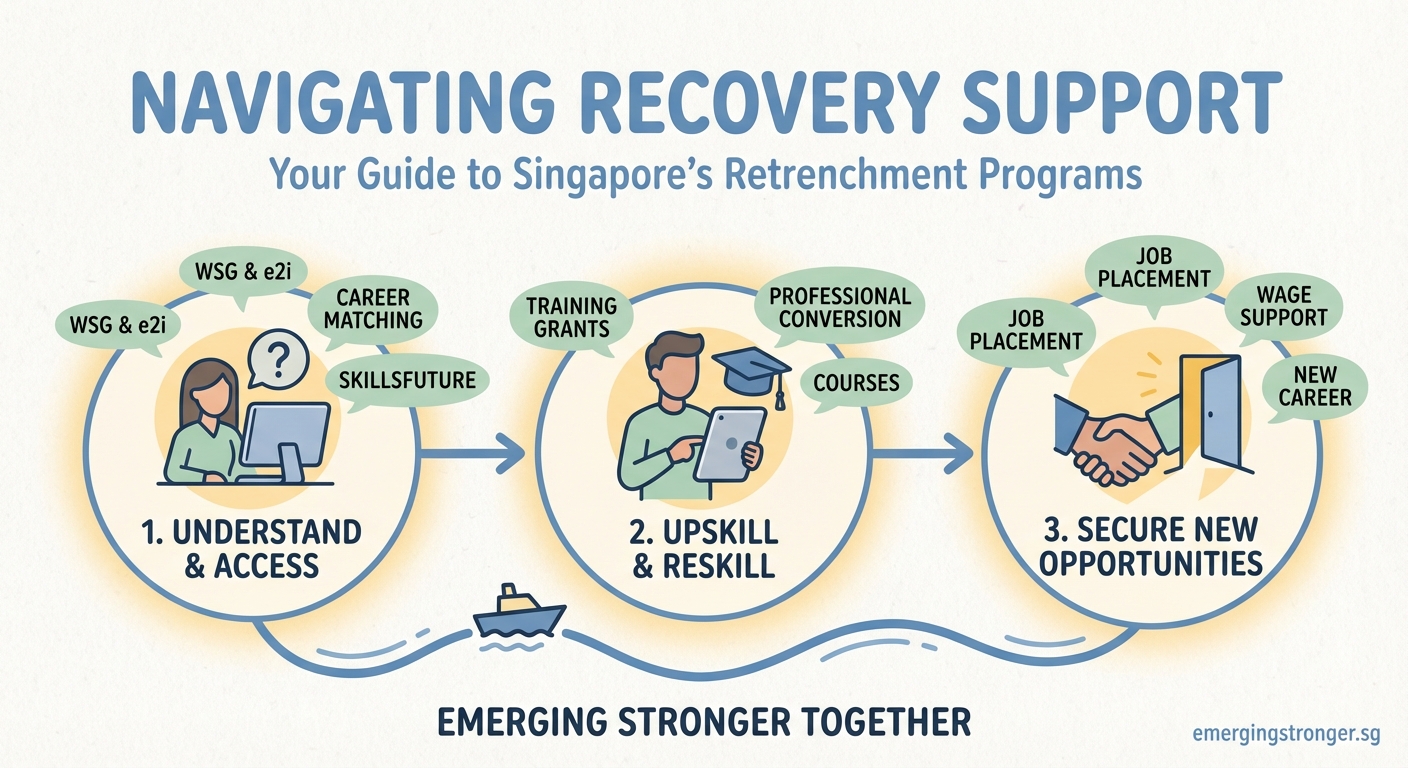
Workforce Singapore (WSG) runs the Career Matching Services specifically for retrenched workers. This isn’t just a job board. You get assigned a career coach who helps you identify transferable skills, refine your resume, and connect with hiring companies.
The service is completely free. Book an appointment online or walk into any WSG career centre. Your coach will assess your situation, help you understand which industries are hiring, and sometimes even arrange interviews directly with employers looking for candidates with your background.
NTUC’s Employment and Employability Institute (e2i) offers similar services with added benefits for union members. Even if you’re not a member, you can still access many of their programs. They run career fairs, host employer networking sessions, and provide one-on-one career counselling.
For immediate financial concerns, check if you qualify for the Self-Employed Person Income Relief Scheme or ComCare assistance. ComCare provides short to medium-term help with basic living expenses while you search for work. The application process takes about two weeks, so apply early.
| Support Program | What It Provides | Who Qualifies | How to Apply |
|---|---|---|---|
| Career Matching Services | Free career coaching and job matching | All retrenched workers | WSG website or career centres |
| SkillsFuture Credit Top-Up | $500 training credit for workers aged 40-60 | Singapore citizens in age range | SkillsFuture portal |
| Workfare Income Supplement | Cash payments for lower-wage workers | Monthly income below $2,300 | Automatic for eligible workers |
| ComCare Short-to-Medium Term Assistance | Financial help for living expenses | Household income below $1,900 per person | Social Service Offices |
| Career Conversion Programmes | Salary support during job transition | Varies by industry | WSG or participating employers |
Step-by-step process to maximize your retrenchment support benefits
Getting the most from available programs requires a systematic approach. Here’s what to do in order:
-
Register with WSG Career Matching Services within the first week of your retrenchment notice. Early registration gives you first access to new job postings and career coaching slots.
-
Update your skills inventory and identify gaps. Use your SkillsFuture credits to take relevant courses before they expire. Courses in data analytics, digital marketing, and project management consistently show strong employment outcomes.
-
Apply for financial assistance programs if your household income qualifies. Don’t wait until you’ve burned through your savings. ComCare and other schemes exist precisely for this transition period.
-
Attend at least two career fairs or networking events per month. E2i and WSG host regular sessions where you can meet employers face-to-face. Bring printed resumes and dress professionally.
-
Consider Career Conversion Programmes if you’re open to switching industries. These programs provide salary support while you train for a new role, reducing the financial risk of career pivoting.
-
Document everything. Keep copies of your retrenchment letter, employment contract, and all correspondence with your former employer. You’ll need these for various applications and potential disputes.
The 5 mental resilience techniques every Singaporean professional should master become especially valuable during this transition period when stress runs high.
Training subsidies and reskilling programs worth your time
Singapore’s reskilling ecosystem is one of the most generous in the world, but not all programs deliver equal value for your job search timeline.
SkillsFuture credits give every Singaporean $500 to spend on approved courses. Workers aged 40 to 60 get an additional $500 top-up. Focus on courses that lead to recognized certifications rather than general interest topics.
The SkillsFuture Career Transition Programme provides course fee subsidies up to 90% for mid-career workers changing industries. You can combine this with absentee payroll funding if you start a new job while training.
Professional Conversion Programmes target specific industries with talent shortages. Technology, healthcare, and logistics sectors frequently offer these programs. They typically include three to six months of structured training followed by guaranteed job placement with a participating employer.
Polytechnics and ITEs run short modular courses designed for working adults. These tend to be more practical and employment-focused than university programs. A three-month course in cloud computing or cybersecurity fundamentals can open doors faster than a year-long diploma.
- Focus on skills with clear job market demand, not just personal interest
- Choose programs offering job placement support or employer partnerships
- Verify that certifications are recognized by Singapore employers
- Calculate the true cost after subsidies before committing
- Check if the training schedule allows you to continue job hunting
Financial planning strategies while between jobs
Your retrenchment package needs to last, and that means getting strategic about expenses immediately.
Calculate your bare-minimum monthly budget. Include only essentials like housing, utilities, food, insurance, and transport. Everything else is negotiable for now. Most people find they can cut 30-40% from their normal spending without major lifestyle changes.
Notify your insurance providers about your employment status. Some policies allow premium holidays or reduced coverage during unemployment. Don’t let policies lapse completely as restarting them later costs more.
If you have outstanding loans, contact your bank proactively. Many offer temporary payment relief or restructuring for retrenched customers. Waiting until you miss payments damages your credit score and limits your options.
CPF contributions stop when you’re unemployed, but you can make voluntary contributions to maintain your retirement planning momentum. Only do this after securing your emergency fund.
The how to build a 6-month emergency fund in Singapore on any salary guide offers practical frameworks for stretching your retrenchment package while building financial resilience.
Consider temporary or contract work to bridge income gaps. Platforms like gig economy apps or temp agencies provide faster placement than permanent roles. The income helps, and you’re still available for interviews for better positions.
Common mistakes that delay your return to employment
Waiting too long to start your job search is the biggest error. Some people take a month to “decompress” after retrenchment. That’s a luxury most can’t afford. Start applying within the first week, even if you’re not feeling emotionally ready.
Applying only to jobs that exactly match your previous role limits your options unnecessarily. Your skills transfer to adjacent roles and industries more than you think. A marketing manager can transition to business development, customer success, or product marketing with minimal retraining.
Ignoring your network is another costly mistake. Seventy percent of jobs in Singapore are filled through referrals and connections, not job boards. Message former colleagues, clients, and industry contacts. Let them know you’re looking. Most people want to help if you make it easy for them.
Skipping the free government services because you think you can handle it alone wastes valuable resources. Career coaches have insider knowledge about which companies are hiring and what they’re looking for. Job matching services can bypass the resume black hole.
Neglecting your mental health during this stressful period affects your interview performance and decision-making. The 7 evidence-based breathing techniques Singapore professionals use to manage workplace stress can help you stay grounded during this transition.
Turning down jobs because they pay slightly less than your previous role can extend your unemployment unnecessarily. A bird in hand beats two in the bush. You can always continue looking while employed, and having recent work experience strengthens your resume.
How to rebuild momentum after the initial shock
The first two weeks after retrenchment often feel surreal. You might cycle through denial, anger, and anxiety. That’s completely normal. But you can’t stay in that headspace if you want to move forward.
Create structure in your days. Treat job hunting like a full-time job because it is. Set your alarm, get dressed, and establish a routine. Spend mornings on applications and networking. Use afternoons for skills development and interview preparation.
Track your applications in a spreadsheet. Record the company, position, date applied, and follow-up actions. This prevents duplicate applications and helps you identify which approaches work best.
Set realistic weekly goals. Aim for 10-15 quality applications rather than 50 rushed ones. Customize each resume and cover letter to the specific role. Generic applications rarely get responses.
Celebrate small wins. A phone screen is progress. A first-round interview is an achievement. A networking coffee chat expands your opportunities. How to rebuild your confidence after a major career setback in Singapore provides frameworks for maintaining momentum when rejection letters pile up.
Join online communities of other job seekers. Reddit’s Singapore jobs forum, LinkedIn groups, and Telegram channels offer peer support and job leads. Knowing others face similar challenges reduces isolation.
Consider volunteering or freelancing in your field. This keeps your skills sharp, fills resume gaps, and sometimes leads to permanent opportunities. Non-profits often need professional expertise they can’t afford to hire.
Accessing mental health support during career transitions
Retrenchment triggers genuine grief. You’ve lost not just income but identity, routine, and social connections. Acknowledging this emotional impact isn’t weakness. It’s smart self-care.
Singapore offers multiple free or low-cost mental health resources. The 5 free mental health services in Singapore you can access today covers options from helplines to subsidized counselling.
Many people find that financial stress compounds emotional distress. How Singapore families can build stronger bonds during financial hardship offers strategies for maintaining family relationships when money gets tight.
Your physical health affects your mental resilience. Maintain exercise routines even if you cancel the gym membership. Free fitness apps, YouTube workout videos, and park connectors provide zero-cost alternatives.
Limit alcohol and avoid using substances to cope with stress. They provide temporary relief but worsen anxiety and depression over time. They also drain your limited budget.
Sleep becomes more important, not less, during stressful periods. Maintain consistent sleep and wake times. Poor sleep sabotages interview performance and decision-making ability.
Real success stories from retrenched Singaporeans who rebuilt careers
Reading about others who’ve successfully navigated retrenchment reminds you that this situation is temporary, not permanent.
The story of how a 42-year-old banker found her second career in Singapore shows how mid-career professionals can pivot successfully even in challenging circumstances.
Many retrenched workers discover opportunities they never would have considered while employed. The forced pause creates space to reassess career satisfaction and explore new directions.
Some use retrenchment as a catalyst to start businesses or become freelancers. The Career Support Programme provides funding and mentorship for aspiring entrepreneurs. Not everyone should start a business, but for some, it’s the right move.
Others find that switching industries leads to better work-life balance or more meaningful work. Career Conversion Programmes make these transitions financially viable by providing salary support during the learning curve.
The common thread in successful transitions isn’t luck. It’s action. People who bounce back fastest start moving immediately, use available resources, and stay open to unexpected opportunities.
Building a stronger foundation for whatever comes next
Retrenchment support Singapore provides gives you tools to navigate this transition. But the real work happens in how you use those tools.
This experience, painful as it is, builds resilience you’ll carry forward. The resilience toolkit for navigating uncertainty in modern Singapore helps you develop skills that protect against future career shocks.
Many people emerge from retrenchment with stronger financial habits, clearer career direction, and better self-awareness. The setback becomes a setup for a more intentional next chapter.
Start building a personal growth plan that actually works while you’re between jobs. You have time now that employed people don’t. Use it strategically.
Document what you’re learning about yourself during this process. Which aspects of your previous job did you miss most? Which parts don’t you miss at all? These insights guide better career decisions going forward.
Your next chapter starts with the first step
Retrenchment feels like an ending, but it’s actually a difficult middle chapter in your larger career story. The support systems exist. The programs work. The question is whether you’ll use them.
Don’t wait for the perfect moment to start. Register with WSG tomorrow. Update your resume this week. Reach out to three contacts by Friday. Small actions compound into momentum, and momentum leads to opportunities.
You’re more capable than you feel right now. The skills that got you this far in your career don’t disappear because one company made a business decision. They’re still there, ready for the next role that needs them. Go claim the support you’ve earned as a Singapore worker, and start writing your comeback story.