
Losing your job doesn’t just empty your calendar. It shakes the foundation of how you see yourself. One day you’re leading projects and mentoring juniors. The next, you’re explaining to your family why you’re home at 10am on a Tuesday. For mid-career professionals in Singapore, where career identity runs deep, a major setback can feel like losing a part of who you are. But confidence isn’t gone. It’s just buried under shock, disappointment, and fear. And you can rebuild it, step by deliberate step.
Rebuilding confidence after a career setback requires acknowledging the [emotional impact](https://www.who.int/health-topics/mental-health), separating your identity from your job title, taking small achievable actions, updating your skills, reconnecting with your professional network, and reframing failure as feedback. This structured approach helps mid-career professionals in Singapore restore self-belief and re-enter the workforce with renewed purpose and clarity.
Understanding Why Career Setbacks Hit Confidence So Hard
Your career isn’t just how you pay bills. It’s how you introduce yourself at gatherings. It’s the answer to “What do you do?” that shapes how others see you and how you see yourself.
In Singapore’s achievement-focused culture, professional success carries enormous weight. Your job title appears on your LinkedIn profile, your business cards, your mental scorecard of whether you’re doing okay in life.
When that disappears through retrenchment, termination, or a failed business venture, the impact goes beyond finances. You lose structure, purpose, and social proof of your competence. You question decisions you made years ago. You wonder if you ever knew what you were doing.
This isn’t weakness. It’s a normal response to a significant loss.
The first step in learning how to rebuild confidence after career setback is recognising that your feelings are valid. You’re not overreacting. You’re processing something genuinely difficult.
Separating Your Identity From Your Job Title
Here’s a truth that sounds obvious but feels revolutionary when you actually apply it: you are not your job.
Your role at a company was one expression of your capabilities. It was never the complete picture of who you are.
Start listing everything you are beyond your last job title:
- A parent who helps with homework
- A friend who gives solid advice
- A person who learned to cook during circuit breaker
- Someone who stayed calm during a family crisis
- A colleague who trained new team members patiently
These qualities don’t vanish when your employment contract ends. They’re portable. They’re real. They’re evidence of competence that exists independent of any company’s decision about headcount.
Write these down. Keep the list visible. When your inner voice says “I’m a failure,” you can point to concrete evidence that you’re a capable person who experienced a setback.
The Confidence Rebuilding Framework for Singapore Professionals
Confidence returns through action, not contemplation. Here’s a structured approach that works:
1. Start With Micro-Achievements
Don’t aim for a new job immediately. That’s too big when you’re feeling shaky.
Instead, set tiny goals you can complete in one day:
- Update one section of your resume
- Send one networking message
- Complete one online course module
- Organise your work documents
- Read one industry article and summarise key points
Each completion sends a signal to your brain: I can still do things. I can still move forward.
These small wins accumulate. After a week of daily micro-achievements, you’ve built momentum. After two weeks, you’ve created a new routine. After a month, you’ve gathered evidence that contradicts the story that you’re stuck.
2. Skill Yourself Up Strategically
The job market changed while you were employed. New tools emerged. New methodologies became standard. Your gap in employment is actually an opportunity to catch up.
Identify three skills that appear repeatedly in job postings for roles you want:
- Technical skills (software, certifications, methodologies)
- Soft skills (communication frameworks, leadership approaches)
- Industry knowledge (trends, regulations, emerging practices)
Singapore offers numerous resources. SkillsFuture credits can fund courses. Community centres run affordable workshops. Online platforms provide flexible learning.
The goal isn’t just gaining knowledge. It’s proving to yourself that you can still learn, adapt, and grow. That proof rebuilds confidence faster than any motivational quote.
Learning something new reminds you that setbacks don’t define your trajectory. Growth does.
3. Reconnect Before You Need Something
Many professionals make this mistake: they only reach out to their network when they need a job referral. That approach feels transactional and makes networking feel uncomfortable.
Instead, reconnect without an agenda.
Message former colleagues to ask how they’re doing. Comment thoughtfully on LinkedIn posts from people in your industry. Attend industry meetups or webinars where you can contribute to discussions.
These interactions serve two purposes. They remind others that you exist and are engaged in your field. More importantly, they remind you that you’re still part of a professional community. You still have insights worth sharing. You still belong.
One conversation where someone says “That’s a great point” can shift your internal narrative from “I’m washed up” to “I still have valuable perspectives.”
4. Reframe the Narrative You Tell Yourself
The story you repeat about your setback shapes your confidence trajectory.
Here are two versions of the same event:
Version A: “I got retrenched because I wasn’t good enough. The company kept others and let me go. That proves I was expendable and mediocre.”
Version B: “I was retrenched during a company restructure that affected my entire department. It was a business decision about cost centres, not a judgment of my individual performance. I gained valuable experience there that I’m now applying to my next chapter.”
Both describe the same situation. One destroys confidence. One preserves it while acknowledging reality.
You’re not lying to yourself with positive thinking. You’re choosing an accurate interpretation that doesn’t catastrophise or personalise business decisions beyond your control.
Practice telling the second version until it becomes your default narrative. The story you tell yourself becomes the reality you live.
Practical Techniques to Rebuild Self-Belief Daily
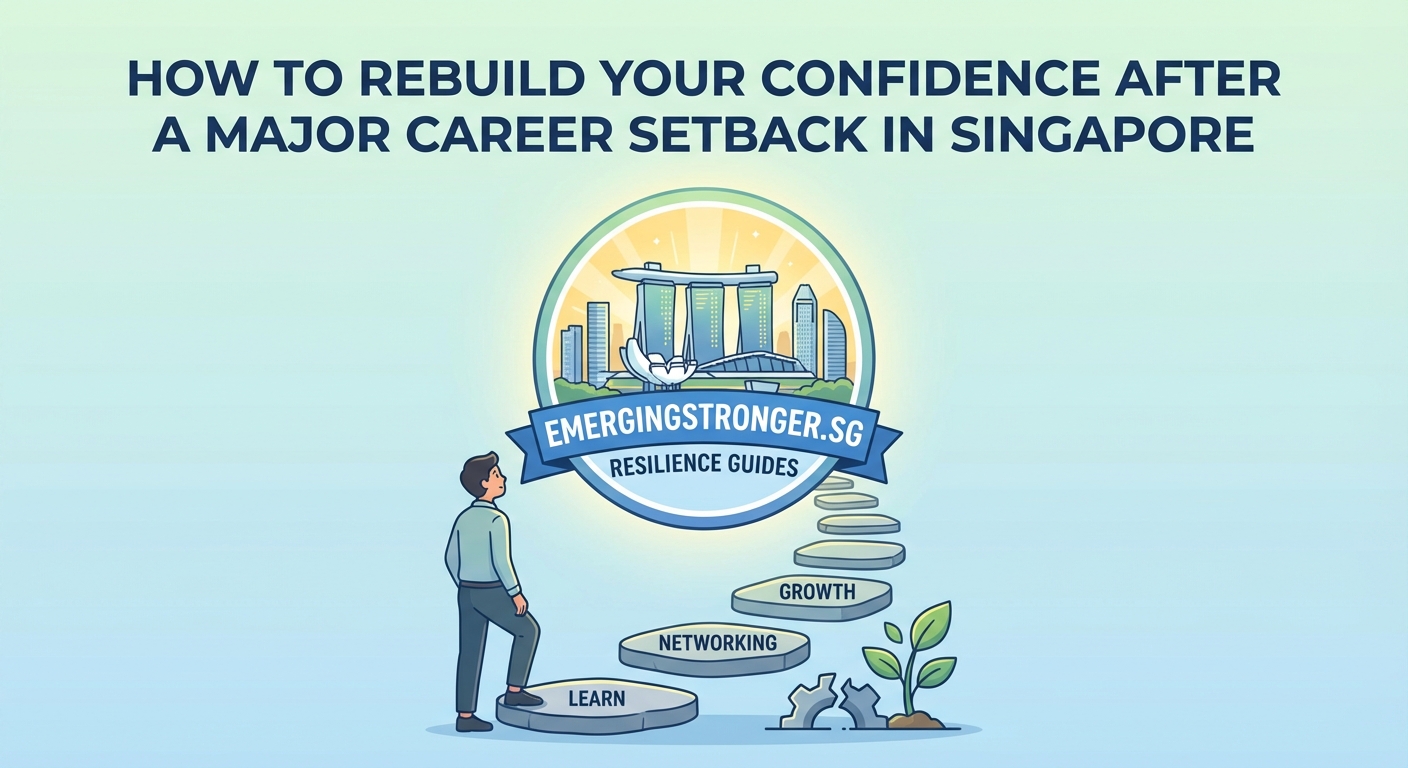
Confidence isn’t rebuilt in one dramatic moment. It’s reconstructed through consistent daily practices that prove you’re capable, valuable, and moving forward.
“Confidence comes from keeping promises to yourself. If you say you’ll do something and you do it, even if it’s small, you’re building trust with yourself. That trust is the foundation of confidence.” (Adapted from resilience research)
Here’s what that looks like in practice:
Morning routine: Start each day by writing three things you’ll accomplish before lunch. Keep them achievable. Complete them. Check them off.
Evidence journal: Each evening, write one thing you did well that day. It can be as simple as “Had a productive conversation” or “Stayed patient when feeling anxious.” This creates a running record that contradicts negative self-talk.
Physical movement: Exercise isn’t just good for health. It’s proof that you can set a goal (run 3km, do 20 push-ups) and achieve it. That transfers to other areas. Singapore’s park connectors and fitness corners make this accessible.
Social connection: Isolation amplifies negative thoughts. Schedule regular contact with friends and family. Their perspective on your worth isn’t tied to your employment status.
Contribution: Volunteer your skills. Help a friend with their resume. Mentor a junior professional. Contribute to online forums in your field. Giving reminds you that you have value to offer.
These aren’t distractions from job hunting. They’re the foundation that makes effective job hunting possible. You can’t present confidently in interviews if you don’t feel confident in daily life.
If you need additional support, 5 free mental health services in Singapore you can access today can provide professional guidance during this transition.
Common Mistakes That Delay Confidence Recovery
Understanding what doesn’t work helps you avoid wasting time and energy on counterproductive approaches.
| Mistake | Why It Hurts | Better Alternative |
|---|---|---|
| Applying to 50 jobs daily without tailoring applications | Creates rejection cycle that confirms negative beliefs | Apply to 5 carefully selected roles with customised applications |
| Isolating yourself from former colleagues | Reinforces feeling of being “out” of professional world | Maintain connections through genuine, non-transactional outreach |
| Comparing your behind-the-scenes to others’ highlight reels | LinkedIn shows success stories, not daily struggles everyone faces | Limit social media; focus on your own progress markers |
| Waiting to feel confident before taking action | Confidence follows action, not the other way around | Act despite discomfort; confidence builds through doing |
| Defining success only as landing a job | Makes every day without offer feel like failure | Celebrate process wins: skills learned, connections made, interviews secured |
The mistake patterns reveal a common thread: they all involve waiting for external validation before feeling worthy. Confidence that depends on others’ approval is fragile. Confidence built on your own consistent action is durable.
Building a Support System That Actually Helps
Not all support is equally useful. Some well-meaning advice actually undermines confidence recovery.
What doesn’t help:
– “Just stay positive!” (Dismisses legitimate feelings)
– “Everything happens for a reason.” (Feels empty when you’re struggling)
– “At least you have your health.” (Minimises real concerns)
– Constant job suggestions without understanding your goals
What does help:
– “This sounds really hard. I’m here to listen.”
– “What kind of support would be most useful right now?”
– Specific offers: “Can I review your resume?” or “Want to practice interview answers?”
– Sharing their own setback stories (not to one-up, but to normalise struggle)
Identify 2-3 people who can provide useful support. Be specific about what you need. “I need someone to hold me accountable to applying to two jobs this week” is more useful than “I need support.”
Consider connecting with others going through similar transitions. Workforce Singapore runs career transition programmes where you’ll meet professionals rebuilding after setbacks. Shared experience reduces isolation and provides practical tips.
Stories like from retrenched to rehired: how a 42-year-old banker found her second career in Singapore demonstrate that others have walked this path successfully.
Managing the Emotional Ups and Downs
Confidence doesn’t return in a straight line. You’ll have good days where you feel capable and motivated. You’ll have bad days where everything feels pointless.
Both are normal. Neither is permanent.
On difficult days:
- Don’t make major decisions
- Stick to your basic routine (the micro-achievements matter even more)
- Use physical techniques to manage anxiety
- Remind yourself that feelings aren’t facts
- Review your evidence journal
When stress feels overwhelming, 7 evidence-based breathing techniques Singapore professionals use to manage workplace stress can provide immediate relief.
On good days:
- Take advantage of momentum to tackle harder tasks
- Reach out to new contacts
- Apply to stretch roles
- But don’t overcommit in ways that will overwhelm you tomorrow
The goal isn’t constant happiness. It’s building resilience through the ups and downs. Each time you navigate a difficult day without giving up, you’re proving to yourself that you can handle adversity. That’s confidence in its truest form.
Developing 5 mental resilience techniques every Singaporean professional should master provides a foundation for long-term emotional stability.
Preparing to Re-Enter the Workforce With Renewed Confidence
Eventually, you’ll reach a point where you’re ready to seriously pursue new opportunities. You’ll know because:
- You can discuss your setback without becoming emotional
- You’ve identified clear next steps for your career
- You have updated skills and knowledge
- Your network is warm and engaged
- You feel genuinely curious about opportunities rather than desperate
At this stage, your rebuilt confidence becomes visible to potential employers. It shows in how you describe your gap in employment. It appears in how you discuss what you learned from the experience. It’s evident in how you present your value proposition.
The interview question “Tell me about your employment gap” becomes an opportunity to demonstrate resilience, learning ability, and self-awareness. These are precisely the qualities employers value in mid-career hires.
Your answer might sound like: “I was part of a department restructure at my previous company. I used that transition period to update my skills in [specific area], reconnect with my professional network, and clarify what I want in my next role. I’m now specifically looking for opportunities where I can apply my experience in [relevant area] while contributing to [company goal].”
That response demonstrates confidence, clarity, and forward focus. It acknowledges reality without dwelling on victimhood. It shows you used the time productively. It connects your past experience to their future needs.
Financial Stability Supports Emotional Recovery
Money stress amplifies every other challenge during career transitions. While this article focuses on confidence, ignoring practical finances would be unrealistic.
If financial pressure is preventing you from thinking clearly about your next steps, how to build a 6-month emergency fund in Singapore on any salary provides actionable guidance for creating a buffer that reduces desperation in your job search.
Financial strain affects family relationships too. How Singapore families can build stronger bonds during financial hardship offers strategies for maintaining family stability during difficult transitions.
When you’re not in panic mode about next month’s rent, you can make better career decisions. You can hold out for roles that genuinely fit rather than grabbing the first offer out of fear. That patience often leads to better long-term outcomes.
Creating Your Personal Comeback Plan
Confidence returns faster when you have a clear plan. Vague intentions like “find a job” or “get back out there” don’t provide enough structure.
Instead, create a specific 90-day plan:
Weeks 1-2: Foundation
– Process emotions (journal, talk to trusted friends, consider counselling if needed)
– Assess finances and create runway plan
– Begin micro-achievement routine
Weeks 3-4: Assessment
– Identify skill gaps in target roles
– Audit your network and reconnect with key contacts
– Update LinkedIn profile and resume
Weeks 5-8: Building
– Complete one significant skill upgrade (course, certification, project)
– Attend 2-3 industry events or webinars
– Conduct 5 informational interviews with people in roles you want
Weeks 9-12: Activation
– Apply to 10-15 carefully selected roles
– Follow up on network conversations
– Practice interview responses
– Continue daily micro-achievements
This framework provides structure without rigidity. Adjust timelines based on your situation. The key is having clear milestones that prove progress even before landing a job offer.
For additional structure, how to build a personal growth plan that actually works in Singapore’s fast-paced environment offers complementary guidance for sustained development.
When Professional Help Makes Sense
Sometimes, confidence issues run deeper than normal setback responses. If you’re experiencing any of these for more than a few weeks, consider professional support:
- Inability to get out of bed or complete basic tasks
- Persistent thoughts that life isn’t worth living
- Panic attacks or severe anxiety that interferes with daily function
- Complete loss of interest in activities you previously enjoyed
- Inability to sleep or sleeping excessively
These aren’t signs of weakness. They’re signals that your brain needs additional support to process what happened. Career counsellors, psychologists, and coaches specialising in transitions can provide frameworks and perspectives you can’t access alone.
Many professionals resist seeking help because they see it as admission of failure. Actually, it’s evidence of self-awareness and commitment to recovery. The fastest path forward often involves expert guidance.
Your Confidence Is Still There
The confidence you had before your setback didn’t evaporate. It’s still there, underneath the shock and disappointment and fear. You’re not starting from zero. You’re clearing away debris to rediscover capabilities that were always yours.
Every professional who’s rebuilt after a major setback followed roughly the same path: acknowledge the pain, separate identity from job title, take small actions consistently, update skills, reconnect with community, reframe the narrative, and move forward despite uncertainty.
You’re not alone in this experience. Thousands of mid-career professionals in Singapore have navigated similar transitions. Many are now in roles they find more fulfilling than what they lost. Your setback might eventually become the turning point that led to something better.
But that only happens if you start rebuilding today. Not tomorrow. Not when you feel ready. Today, with one small action that proves you’re moving forward.
What’s your first micro-achievement going to be?