
You’re working 50-hour weeks at Raffles Place, scrolling through LinkedIn at midnight, wondering why everyone else seems to have their career sorted while you’re stuck in the same role for three years. Sound familiar? Building a personal growth plan in Singapore isn’t about copying what worked for someone in Silicon Valley or London. Our city-state demands a different approach, one that accounts for the MRT commute, the hawker centre lunches, and the unspoken expectation that you’ll reply to emails after 10pm.
A personal growth plan Singapore professionals actually follow combines specific career milestones with measurable skill development, anchored to local realities like [CPF contributions](https://www.cpf.gov.sg/member) and industry cycles. Success requires weekly reviews, quarterly adjustments, and building support systems that work within our 24/7 work culture. Start small, track progress religiously, and align your plan with both personal values and market demands.
Why Generic Growth Plans Fail in Singapore
Most personal development templates assume you have time. They assume your boss respects boundaries. They assume you can take a sabbatical to “find yourself” in Bali.
That’s not how things work here.
Singapore’s work culture operates on speed and efficiency. The average professional here clocks more hours than counterparts in Tokyo or New York. Add in family obligations, NS commitments for men, and the constant pressure to upskill before AI takes your job, and you’ve got a recipe for burnout disguised as ambition.
Generic plans also ignore our unique ecosystem. Your career trajectory depends heavily on which industry you’re in, whether you’ve got the right certifications from SkillsFuture, and how well you network at those awkward Friday evening mixers. A personal growth plan that doesn’t account for these factors is just motivational fluff.
The Three Pillars Every Singapore Growth Plan Needs

A functional personal growth plan Singapore working professionals can stick to rests on three foundations. Miss one, and the whole structure wobbles.
Career Capital
This means skills, credentials, and connections that increase your market value. Not just any skills but the ones hiring managers actually search for on LinkedIn. Think AWS certifications if you’re in tech, CFA if you’re in finance, or advanced Excel if you’re in operations.
Track what’s in demand by checking job postings every quarter. Notice patterns. If five different roles ask for Tableau experience, that’s your signal.
Energy Management
You can’t execute a growth plan when you’re running on three hours of sleep and kopi ping. Energy management in Singapore means protecting your recovery time despite cultural pressure to always be “on.”
This includes setting hard boundaries around sleep, scheduling exercise like you’d schedule a client meeting, and recognising when you need professional support. Resources like 5 free mental health services in Singapore you can access today exist for a reason.
Progress Tracking
What gets measured gets managed. Your growth plan needs concrete metrics, not vague aspirations. “Get better at presentations” means nothing. “Deliver three client presentations without reading from slides by June” gives you something to work toward.
Use a simple spreadsheet or notion board. Review it every Sunday evening. Adjust when life throws you a curveball, which it will.
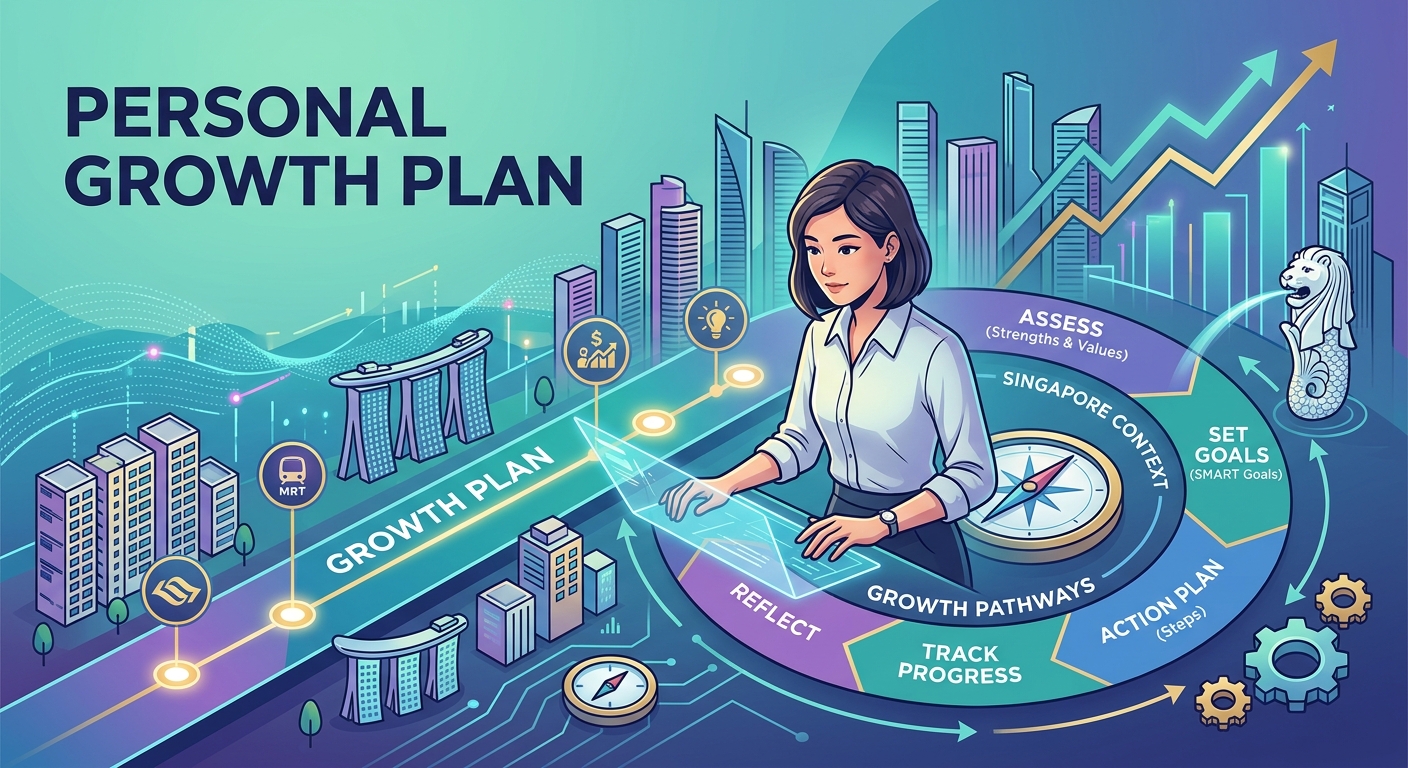
Building Your Personal Growth Plan in Six Steps
Here’s the framework that works for professionals juggling 60-hour work weeks and family dinners at Tiong Bahru.
1. Audit Your Current State
Block out two hours on a Saturday morning. Grab a notebook and answer these:
- What skills do I use daily at work?
- What skills do I wish I had?
- Where do I want to be in 18 months?
- What’s holding me back right now?
Be brutally honest. If you’re terrible at public speaking, write it down. If you’ve been procrastinating on that Python course for eight months, acknowledge it.
2. Define Three Clear Outcomes
Pick three specific outcomes you want to achieve in the next year. Make them measurable and relevant to your actual life.
Examples:
– Secure a senior analyst role with $6,500 base salary
– Complete AWS Solutions Architect certification
– Build a professional network of 15 industry contacts
Notice these aren’t personality changes. You’re not trying to “become more confident.” You’re aiming for tangible results that move your career or life forward.
3. Break Down the Path
For each outcome, list the steps needed to get there. Be specific about what you’ll do each month.
If your goal is the senior analyst role:
– Month 1-2: Update resume, research companies, identify skill gaps
– Month 3-4: Take online course to fill gaps, start applying
– Month 5-6: Network with people in target roles, refine interview skills
– Month 7-12: Continue applications, negotiate offers
4. Schedule Weekly Actions
Your plan lives or dies based on what you do this week. Not next month. This week.
Every Sunday, identify three actions you’ll complete before Friday. Block time in your calendar for them. Treat these blocks like meetings with your CEO because that’s essentially what they are.
One action might be “Spend 90 minutes on SQL tutorial Tuesday 8-9:30pm.” Another could be “Message two former colleagues about their current roles by Wednesday.”
5. Build Accountability Systems
You need external pressure because willpower fails. Options that work in Singapore:
- Join a mastermind group (many operate via Telegram)
- Hire a coach for quarterly check-ins
- Partner with a colleague working on similar goals
- Share monthly progress with a trusted friend
The format matters less than the consistency. Someone needs to ask you every month, “Did you do what you said you’d do?”
6. Review and Adjust Quarterly
Set calendar reminders for the last Sunday of March, June, September, and December. Spend an hour reviewing:
- What worked?
- What didn’t?
- What changed in my industry or personal life?
- Do I need to adjust my goals or timeline?
Singapore’s job market shifts fast. A skill that was hot in January might be oversaturated by July. Your plan needs to flex with reality.
Common Mistakes That Derail Progress
| Mistake | Why It Happens | How to Fix It |
|---|---|---|
| Setting too many goals | Fear of missing out, cultural pressure to excel everywhere | Pick three maximum, say no to the rest |
| No time blocking | Treating growth activities as optional | Schedule them like doctor appointments |
| Ignoring energy levels | Hustle culture glorifies exhaustion | Track when you’re most productive, plan accordingly |
| Copying someone else’s path | LinkedIn makes everyone look successful | Build a plan based on your strengths and constraints |
| Skipping the review process | Too busy executing to reflect | Set non-negotiable quarterly review dates |
The biggest trap is thinking you need to overhaul your entire life. You don’t. Small, consistent actions compound over time. Thirty minutes three times a week beats a five-hour Saturday binge session you’ll abandon by week three.
Adapting Your Plan to Singapore’s Work Culture
Let’s be real about the challenges here. Your manager might expect you on Slack at 9pm. Your team might schedule meetings during lunch. Your industry might require you to attend networking events when you’d rather be home with your family.
Your personal growth plan needs to work within these constraints, not pretend they don’t exist.
Use your commute strategically
The average Singaporean spends 84 minutes commuting daily. That’s seven hours a week you could use for podcasts, audiobooks, or mobile learning apps. Download content when you have WiFi, consume it on the train.
Leverage SkillsFuture credits
You’ve got government money sitting there. Use it for courses that align with your growth plan. Many providers offer evening or weekend options designed for working professionals.
Network during work hours when possible
Instead of adding evening events to your calendar, suggest coffee meetings before work or lunch near your office. Most professionals prefer this too.
Protect one evening a week
Pick Tuesday or Wednesday. Make it sacred. No work calls, no networking events, no checking email. Use this time for deep work on your growth plan or simply to recharge. Techniques like those covered in 7 evidence-based breathing techniques Singapore professionals use to manage workplace stress can help you maximise this recovery time.
Tools That Actually Help
You don’t need fancy software. Most successful professionals use:
- Google Calendar for time blocking
- Notion or Trello for tracking projects and goals
- Google Sheets for metrics and progress
- Telegram groups for accountability
- LinkedIn for industry research and networking
The tool matters far less than how consistently you use it. Pick one system and stick with it for at least three months before switching.
When to Get Professional Support
Sometimes you need more than a personal growth plan. You need actual help.
Consider reaching out if:
- You’ve been stuck in the same role for over three years despite trying
- Burnout is affecting your health or relationships
- You’re facing a major career transition and don’t know where to start
- Mental health challenges are blocking your progress
Stories like from retrenched to rehired: how a 42-year-old banker found her second career in Singapore show that setbacks aren’t permanent. Getting support is smart, not weak.
Career coaches, therapists, and mentors exist for a reason. The best time to find them is before you’re in crisis mode.
Making Your Plan Resilient
Singapore’s economy cycles through booms and corrections. Your industry might face disruption. Your company might restructure. A global pandemic might upend everything.
Your personal growth plan needs resilience built in. This means:
- Developing transferable skills, not just role-specific ones
- Building financial buffers that give you options
- Maintaining relationships across multiple companies and industries
- Staying informed about adjacent fields you could pivot into
The professionals who thrive here aren’t the ones with perfect plans. They’re the ones whose plans can bend without breaking. Building mental resilience techniques every Singaporean professional should master becomes part of the growth plan itself.
Sample Weekly Routine for Busy Professionals
Here’s what a realistic week might look like:
Monday
– Morning commute: Listen to industry podcast (30 min)
– Lunch: Read one article related to skill development (15 min)
Tuesday
– Protected evening: Work on certification course (90 min)
Wednesday
– Morning: Coffee meeting with industry contact (45 min)
Thursday
– Evening: Online workshop or webinar (60 min)
Friday
– Lunch: Update progress tracker (10 min)
Saturday
– Morning: Deep work on major project (2 hours)
Sunday
– Evening: Weekly review and planning (30 min)
Total time investment: About 6-7 hours weekly. That’s less than one full workday, spread across the week in manageable chunks.
Measuring What Matters
Your personal growth plan Singapore style needs metrics that reflect real progress, not vanity numbers.
Good metrics:
– Number of job interviews secured
– Salary increase percentage
– Certifications completed
– Professional contacts who respond to your messages
– Projects you can showcase in your portfolio
Bad metrics:
– LinkedIn profile views
– Online courses started but not finished
– Books purchased but not read
– Networking events attended where you knew no one
Focus on outcomes, not activity. Attending 12 networking events means nothing if you didn’t build any real relationships.
“The best personal growth plan is the one you’ll actually follow for 12 months straight. Start with what feels manageable, build the habit, then increase intensity. Most people do the opposite and quit by February.” – Career coach working with Singapore professionals since 2015
Your First 30 Days
If you’re starting today, here’s your roadmap for the next month:
Week 1: Foundation
– Complete your current state audit
– Define your three main outcomes
– Set up your tracking system
Week 2: Planning
– Break down each outcome into monthly milestones
– Identify your first three weekly actions
– Find an accountability partner or system
Week 3: Execution
– Complete your three weekly actions
– Track time spent and energy levels
– Adjust your schedule based on what worked
Week 4: Review
– Assess what you accomplished
– Identify obstacles that came up
– Plan the next month’s priorities
By the end of 30 days, you’ll know if your plan is realistic or needs adjusting. You’ll have momentum. You’ll have data about what works for your specific situation.
Growing Without Burning Out
The paradox of building a personal growth plan in Singapore is that you’re already stretched thin. Adding more to your plate without removing something else is a recipe for failure.
Before you start any growth plan, identify what you’ll stop doing. Maybe it’s scrolling Instagram for 45 minutes before bed. Maybe it’s saying yes to every social invitation. Maybe it’s that side project that’s been dragging for eight months with no progress.
Create space before you fill it with new commitments.
Also remember that rest is productive. Sleep, exercise, and time with people you care about aren’t obstacles to your growth plan. They’re essential components. Professionals who sustain long-term growth understand this. Those who burn out don’t.
Making It Stick When Motivation Fades
Motivation is unreliable. You’ll feel excited for the first two weeks, then life will happen. Your boss will dump an urgent project on you. Your kid will get sick. Your MRT line will have delays three days in a row.
This is when systems save you.
Your weekly review reminds you to get back on track. Your accountability partner asks uncomfortable questions. Your calendar blocks force you to show up even when you don’t feel like it.
The goal isn’t perfect execution. It’s consistent effort over time. Missing a week doesn’t ruin your plan. Giving up does.
Your Growth Plan Starts Now
You’ve got the framework. You understand the local context. You know the common mistakes and how to avoid them.
The difference between people who grow their careers and those who stay stuck isn’t talent or luck. It’s having a plan and working it consistently, week after week, even when progress feels slow.
Your personal growth plan Singapore edition won’t look like anyone else’s, and that’s exactly how it should be. Build something that fits your life, your goals, and your constraints. Review it regularly. Adjust when needed. Keep showing up.
Start with your Sunday evening review this week. Block 30 minutes. Answer the audit questions. Pick your three outcomes. That’s all you need to begin.