You are staring at your laptop screen for the tenth hour straight. Slack notifications keep piling up. The MRT was delayed again this morning. Your lunch was a sad chicken rice packet eaten at your desk. By 4pm, your brain feels like static. You wonder if this is just how life is supposed to feel in Singapore. It is not. Resilience is not something you are born with. It is a set of daily practices that rewire how you respond to pressure. And you can start building it today without quitting your job or moving to a cabin in Tasmania.
Resilience in Singapore’s fast-paced environment comes from small, repeatable daily habits. This guide shows you seven evidence-based practices to manage workplace stress, protect your mental energy, and bounce back from setbacks. You will learn the exact routines that help professionals in Singapore stay calm under pressure and build long-term mental toughness without burning out.
Why Singapore Needs a Different Approach to Resilience
The pressure here is unique. You face long working hours, a high cost of living, and a culture that often equates busyness with success. Your colleagues seem to thrive on iced kopi and sheer willpower. But the truth is that many professionals in Singapore are running on fumes.
Building resilience is not about becoming a robot who never feels stress. It is about creating a recovery system that lets you handle pressure and then genuinely recharge. The habits below are designed for your reality. They fit around your meetings, your commute, and your family commitments. No retreats. No expensive apps. Just practical shifts that compound over time.
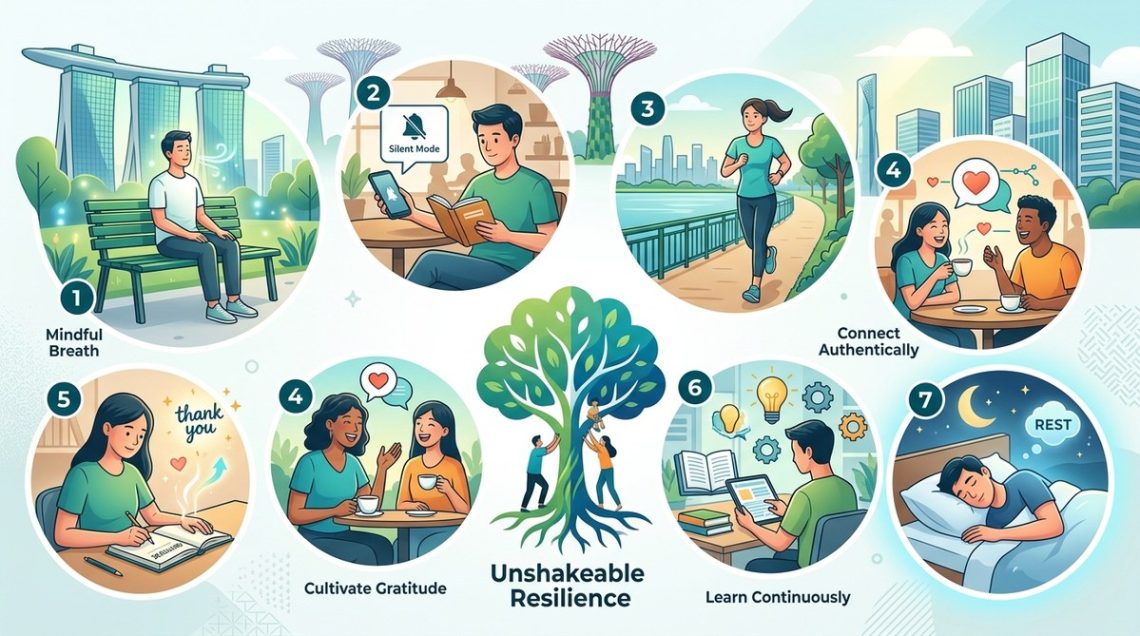
The 7 Daily Habits That Build Mental Toughness
These habits are listed in the order you can weave them into your day. Start with one. Master it. Then add the next.
1. The Five-Minute Morning Anchor
Before you grab your phone, sit on the edge of your bed. Set a timer for five minutes. Breathe naturally. That is it. This practice stops the day from hijacking you before you have even stood up.
Most people in Singapore start their day by checking emails or scrolling social media. That puts you in a reactive state immediately. The five-minute anchor puts you in a calm, intentional state. You are telling your nervous system that you are safe before the chaos begins.
Try this: place your phone across the room tonight. When the alarm rings, sit up and just breathe. No phone until you have finished those five minutes.
2. Strategic Micro-Breaks Between Meetings
Back-to-back Zoom calls are a resilience killer. Your brain needs transition time. A micro-break is any pause of two to five minutes where you deliberately shift your focus away from work.
Here is what a micro-break looks like:
- Stand up and stretch for 90 seconds
- Look out the window at something green (trees, plants, the sky)
- Drink a glass of water without checking your phone
- Do three slow breaths before joining the next call
These breaks lower your cortisol levels and reset your attention. Without them, stress accumulates across the day like interest on bad debt.
3. Emotional Labeling
When you feel overwhelmed, name the emotion out loud or in your head. Say “I am feeling anxious right now” or “This is frustration.” That simple act reduces the intensity of the feeling.
Psychologists call this “affect labeling.” It activates the prefrontal cortex, which helps regulate the amygdala. In plain language: naming the feeling calms the alarm system in your brain.
You can do this during a meeting, on the MRT, or while stuck in ERP traffic on the CTE. No one needs to know you are doing it.
4. The One-Promise Rule
Every day, make one small promise to yourself and keep it. The promise must be achievable and personal. Examples:
- “I will eat lunch away from my desk today.”
- “I will leave the office by 6.30pm.”
- “I will call a friend for five minutes.”
- “I will not check work messages after 9pm.”
This habit rebuilds trust with yourself. When you break promises to yourself repeatedly, your self-worth erodes. Keeping one small promise every day restores that trust. It is the foundation of building resilience after setbacks.
5. Physical Reset
Your body holds your stress. If you sit still for ten hours, your nervous system stays locked in a sympathetic state (fight or flight). You need movement to signal safety to your brain.
A physical reset does not require a gym session. It can be:
- A ten-minute walk around your estate
- Climbing the stairs in your office building
- Five minutes of stretching in your living room
- A brisk walk from Raffles Place to Marina Bay
The key is to move until you feel a shift in your body. That might be a deep breath, a loosening of your shoulders, or a moment of mental quiet.
6. Digital Wind-Down Window
Set a cut-off time for screens. Thirty minutes before you sleep, put your phone away. Read a physical book. Journal. Talk to your partner. Just sit quietly.
Blue light suppresses melatonin. Work emails activate your stress response. Social media creates comparison anxiety. All three together make it impossible for your brain to rest.
Singapore runs on a 24-hour work culture. But you can choose to protect your sleep. Good sleep is the single most important factor in how to cultivate mental resilience.
7. End-of-Day Reflection
Before you sleep, write down one win from the day and one thing you learned. The win can be tiny. “I finished that report.” “I stayed calm during a difficult conversation.” “I ate a proper dinner.”
The lesson can be simple. “I should not check email right before bed.” “Asking for help is okay.”
This practice trains your brain to scan for positive moments instead of dwelling on failures. Over time, it rewires your default thinking pattern toward growth.
Common Mistakes vs Resilient Alternatives
Here is a table that compares what typically drains resilience with what actually builds it. Use this as a cheat sheet.
| Common Mistake | Why It Backfires | Resilient Alternative |
|---|---|---|
| Skipping lunch to save time | Blood sugar crashes, irritability, poor decision-making | Eat a proper meal away from your screen |
| Checking work messages until midnight | Poor sleep quality, chronic fatigue, reduced focus | Set a hard cut-off by 9pm |
| Avoiding difficult conversations | Stress festers, relationships suffer, problems grow | Name the issue early with honesty |
| Saying yes to every request | Overcommitment, resentment, loss of boundaries | “Let me check my capacity and get back to you” |
| Comparing yourself to colleagues on LinkedIn | Anxiety, imposter syndrome, distorted self-view | Limit social media to 10 minutes per day |
| Working through illness | Burnout, longer recovery, lower performance | Rest at the first sign of sickness |
| Holding everything inside | Emotional isolation, heightened stress, physical symptoms | Talk to a trusted friend or a professional |
Expert advice from Dr. Lim Hui Ying, clinical psychologist practicing in Singapore: “Resilience is often misunderstood as pushing through pain. True resilience is the ability to recover. It requires rest, reflection, and community. The most resilient professionals I work with are not the ones who work the longest hours. They are the ones who protect their recovery time fiercely.”
A Simple Process to Start Building Resilience Today
You do not need to change everything at once. Use this numbered process to get started without feeling overwhelmed.
- Pick one habit from the list above. Choose the one that feels easiest to try tomorrow.
- Set a specific trigger. Attach the habit to something you already do. For example: “After I brush my teeth in the morning, I will sit for five minutes.” Or “Before I open my laptop, I will drink a full glass of water.”
- Do it for seven days. Do not add another habit until you have done the first one consistently for a week.
- Review and adjust. Ask yourself: Did this habit make my day better? If yes, keep it. If not, tweak the timing or try a different habit.
- Add the next habit. Once the first habit feels automatic, repeat the process with a second one.
This gradual approach prevents the all-or-nothing trap. Many people try to overhaul their entire routine in one weekend and then give up by Wednesday. Small steps create lasting change.
What Resilience Looks Like in Singapore
Resilience in our context is not about becoming fearless. It is about feeling the fear, the pressure, and the exhaustion, and still choosing to take care of yourself. It is the senior executive who leaves the office at 6pm to have dinner with her kids. It is the entrepreneur who took three months off after a failed startup and came back stronger. It is the new hire who admits he does not understand something instead of pretending.
You do not have to be perfect at these habits. You just have to be consistent. Some days you will fail. That is part of the process. The goal is not to never fall. The goal is to fall, get back up, and learn something that makes the next fall less likely.
If you want to see real examples of people in Singapore who have done exactly that, read the story of the hawker who bounced back after losing everything or how a 42-year-old banker found her second career after retrenchment.
Your Resilience Toolkit
To build resilience in Singapore, you need more than just willpower. You need a set of reliable tools. Here are five resources that support the habits above:
- A simple notebook for your end-of-day reflection and emotional labeling
- A water bottle that stays on your desk to remind you to hydrate
- A pair of comfortable walking shoes kept under your desk for micro-breaks
- A physical book on your nightstand to replace phone scrolling
- A list of three people you can call when you need to talk (include at least one who will listen without giving advice)
These are not fancy investments. They are practical reminders that you are committed to your own well-being.
For a deeper look at the science behind these practices, check out why some people bounce back faster than others. Understanding the biology of stress and recovery can make these habits feel more meaningful.
Small Habits, Big Shifts Over Time
Resilience is not built in a day. It is built in the small moments you choose yourself. The five minutes of quiet before the chaos. The walk around the block instead of another coffee. The honest conversation instead of silent resentment. The early night instead of another episode.
These choices feel small in the moment. But over weeks and months, they compound into something unshakeable. You become the person who can handle the pressure of Singapore without losing yourself.
Start tomorrow morning. Sit on the edge of your bed for five minutes. Breathe. Let your brain wake up before the world demands your attention. That single act is the beginning of a more resilient life.
If you are ready to go deeper, consider taking the 30-day resilience challenge for busy professionals. It walks you through each habit day by day with prompts and reflections.
You have what it takes to build resilience in Singapore. You just need the right habits and the courage to start.