You’re sitting at your desk in the middle of Raffles Place. Your inbox has 47 unread emails. Three meetings back-to-back just ended, and another one starts in 10 minutes. Your shoulders are tense. Your jaw is clenched. And that familiar knot in your stomach is back.
Sound familiar? You’re not alone. A 2023 study by the Singapore Ministry of Health found that 1 in 7 working adults in Singapore experiences anxiety or stress-related disorders. The good news? You already carry the most powerful stress-relief tool with you everywhere: your breath.
Breathing techniques for workplace stress offer immediate, evidence-based relief without leaving your desk. These seven methods activate your [parasympathetic nervous system](https://en.wikipedia.org/wiki/Parasympathetic_nervous_system), reducing cortisol levels and anxiety within minutes. From box breathing to alternate nostril breathing, each technique addresses specific workplace stressors like pre-meeting nerves, deadline pressure, and mental fatigue. Practice regularly to build resilience and improve your overall mental wellbeing at work.
Why Your Breath Matters More Than You Think
Your breathing pattern directly influences your nervous system. When you’re stressed, your breath becomes shallow and rapid. This triggers your sympathetic nervous system, the fight-or-flight response that makes your heart race and your palms sweat.
Controlled breathing does the opposite. It activates your parasympathetic nervous system, which tells your body it’s safe to relax. Studies from the National University of Singapore show that just three minutes of focused breathing can lower cortisol levels by up to 25%.
The best part? You don’t need a quiet room, a yoga mat, or special equipment. You can practice these techniques at your desk, in the lift, or even during a video call with your camera off.
The Science Behind Breathing Techniques for Workplace Stress
Before we get into the specific techniques, let’s understand what happens in your body.
Your vagus nerve connects your brain to your heart, lungs, and digestive system. When you breathe slowly and deeply, you stimulate this nerve. It sends a signal to your brain: “Everything is okay. You can calm down now.”
This process, called vagal tone stimulation, has measurable effects. Your heart rate slows. Your blood pressure drops. Your muscles release tension. Even your digestive system works better.
Research published in the Journal of Clinical Psychology found that participants who practiced controlled breathing for 10 minutes daily experienced a 44% reduction in workplace anxiety over four weeks.
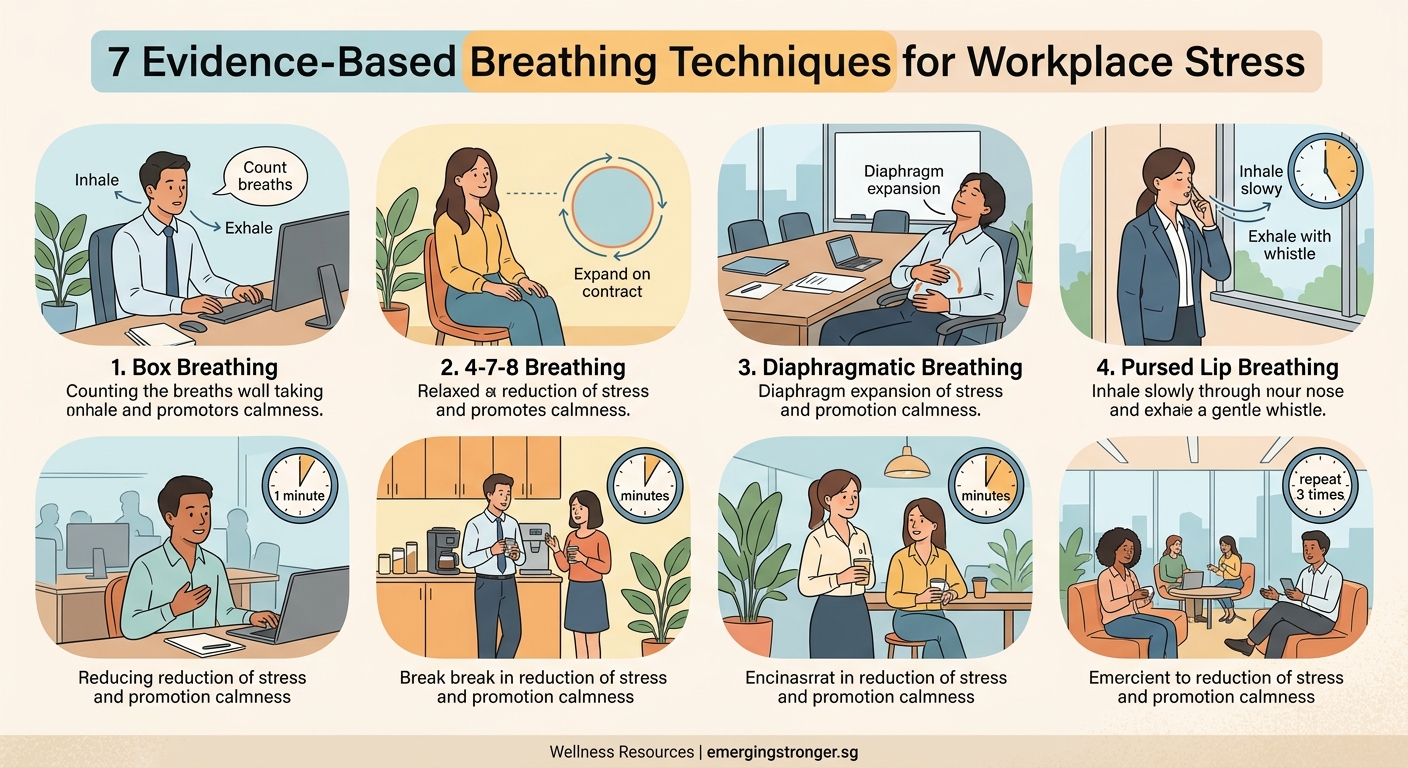
Seven Evidence-Based Techniques You Can Start Today
Here are seven breathing methods that Singapore professionals actually use. Each one targets different workplace stressors.
1. Box Breathing for High-Pressure Moments
Box breathing, also called square breathing, creates a rhythm that grounds you instantly.
How to practice:
1. Breathe in through your nose for 4 counts
2. Hold your breath for 4 counts
3. Breathe out through your mouth for 4 counts
4. Hold empty for 4 counts
5. Repeat for 2-3 minutes
This technique is perfect right before a presentation or difficult conversation. Navy SEALs use it to stay calm under extreme pressure. You can use it before your quarterly review.
Sarah, a senior manager at a fintech company in Tanjong Pagar, practices box breathing in the toilet cubicle before every board meeting. “It takes two minutes,” she says. “But it completely changes how I show up.”
2. The 4-7-8 Method for Racing Thoughts
When your mind won’t stop spinning, the 4-7-8 technique creates an immediate shift.
The process:
1. Empty your lungs completely
2. Breathe in through your nose for 4 counts
3. Hold for 7 counts
4. Exhale slowly through your mouth for 8 counts
5. Repeat 4 times
The extended exhale is key. It forces your body to release more carbon dioxide, which triggers the relaxation response. This method works especially well when you’re lying in bed at 2am, worrying about tomorrow’s deadline.
Dr. Andrew Weil, who popularized this technique, calls it a “natural tranquilizer for the nervous system.” Unlike actual tranquilizers, the effects get stronger with practice.
3. Diaphragmatic Breathing for Sustained Calm
Most people breathe from their chest. This shallow breathing actually maintains stress. Diaphragmatic breathing, or belly breathing, uses your full lung capacity.
Here’s how:
1. Place one hand on your chest, one on your belly
2. Breathe in slowly through your nose
3. Feel your belly rise while your chest stays relatively still
4. Exhale slowly, feeling your belly fall
5. Continue for 5-10 minutes
This technique reduces the physical symptoms of stress. Your shoulders drop. Your neck muscles relax. The tension headache that’s been building all morning starts to fade.
Practice this during your lunch break. Sit in the office pantry or find a quiet corner in a nearby park. Ten minutes of diaphragmatic breathing can reset your entire afternoon.
4. Alternate Nostril Breathing for Mental Clarity
This yogic technique, called Nadi Shodhana, balances both hemispheres of your brain. It sounds unusual, but the research backs it up.
The method:
1. Sit comfortably with your spine straight
2. Close your right nostril with your right thumb
3. Inhale slowly through your left nostril
4. Close your left nostril with your ring finger
5. Open your right nostril and exhale
6. Inhale through the right nostril
7. Switch and exhale through the left
8. Continue for 3-5 minutes
A 2022 study from the Singapore General Hospital found that alternate nostril breathing improved focus and decision-making in healthcare workers during high-stress shifts.
Use this technique when you need to think clearly. Before writing an important email. Before making a significant decision. Before a brainstorming session where you need to be sharp.
5. Breath Counting for Grounding
When anxiety makes everything feel overwhelming, counting your breaths brings you back to the present moment.
Simple steps:
1. Sit or stand comfortably
2. Breathe naturally, without controlling the rhythm
3. Count each exhale: 1, 2, 3, 4, 5
4. Start over at 1 after reaching 5
5. Continue for 3-10 minutes
If you lose count, that’s fine. Just start again at 1. The goal isn’t perfect counting. The goal is giving your mind something simple to focus on instead of spiraling thoughts.
This technique pairs well with walking. Count your breaths as you walk from the MRT station to your office. Or during a loop around the building between meetings.
6. Physiological Sigh for Immediate Relief
Stanford neuroscientist Dr. Andrew Huberman discovered that this breathing pattern provides the fastest stress relief.
The technique:
1. Take a deep breath in through your nose
2. When your lungs feel full, take a second, smaller sip of air
3. Exhale slowly and completely through your mouth
4. Repeat 1-3 times
That double inhale is crucial. It reinflates the tiny air sacs in your lungs that collapse during stress. This immediately signals safety to your nervous system.
Use this when you feel panic rising. When someone sends a passive-aggressive email. When your manager announces unexpected changes. One or two physiological sighs can stop a stress spiral before it starts.
7. Extended Exhale Breathing for Evening Wind-Down
Many Singapore professionals struggle to switch off after work. Your body is still in work mode even though you’re home.
The practice:
1. Breathe in for 3 counts
2. Breathe out for 6 counts
3. Keep the exhale twice as long as the inhale
4. Continue for 5-10 minutes
The extended exhale activates your rest-and-digest system. It tells your body that the workday is over. You’re safe now. You can relax.
Practice this on the MRT ride home. Or right after you close your laptop for the day. It creates a clear boundary between work stress and personal time.
Comparing the Seven Techniques
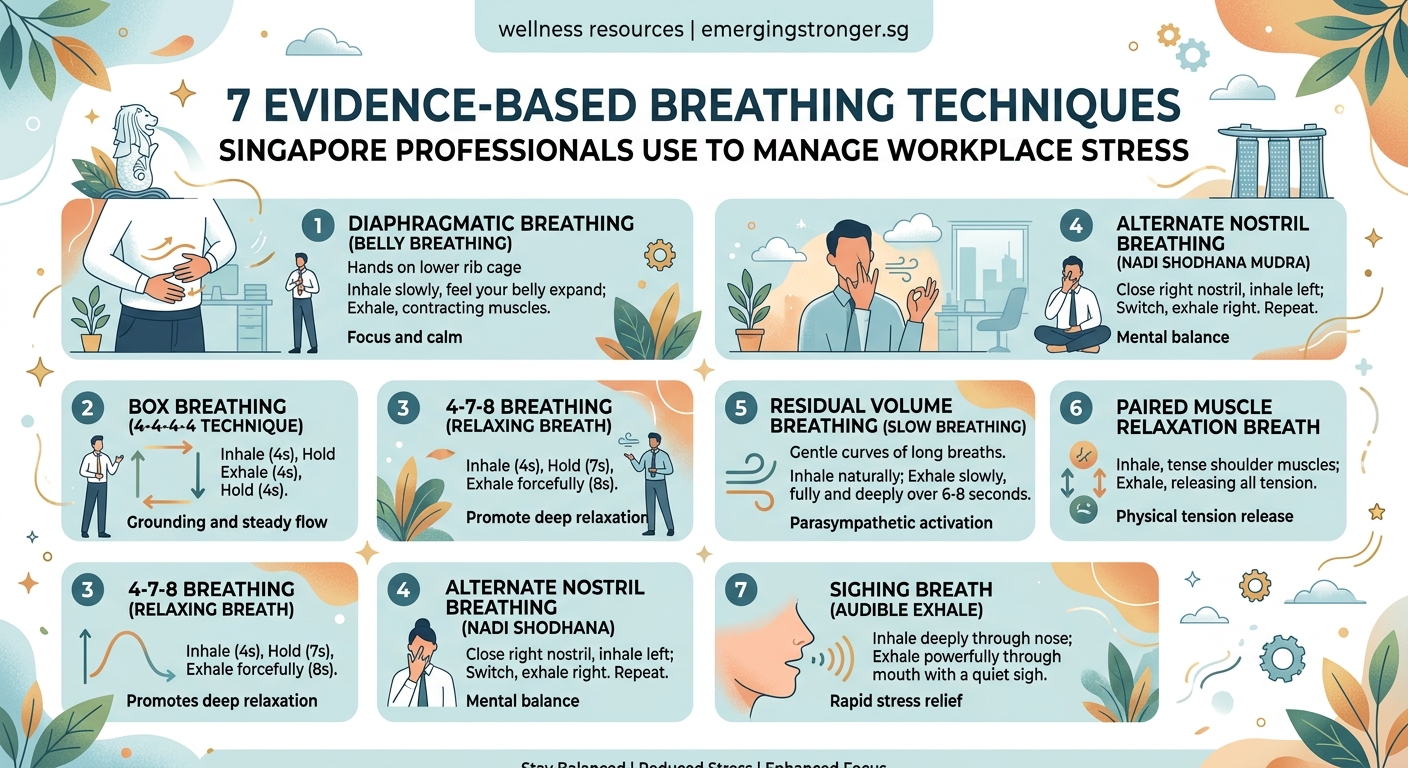
Different situations call for different approaches. Here’s how to choose:
| Technique | Best For | Time Needed | Difficulty |
|---|---|---|---|
| Box Breathing | Pre-meeting nerves | 2-3 minutes | Beginner |
| 4-7-8 Method | Racing thoughts | 2 minutes | Beginner |
| Diaphragmatic Breathing | Physical tension | 5-10 minutes | Beginner |
| Alternate Nostril | Mental clarity | 3-5 minutes | Intermediate |
| Breath Counting | Overwhelming anxiety | 3-10 minutes | Beginner |
| Physiological Sigh | Immediate panic | 30 seconds | Beginner |
| Extended Exhale | Evening wind-down | 5-10 minutes | Beginner |
Common Mistakes and How to Avoid Them
Even simple breathing techniques can go wrong if you’re not careful. Here are the most common errors:
Breathing too deeply too fast. This causes hyperventilation. You might feel dizzy or lightheaded. Start slowly. Let your body adjust to the new pattern.
Forcing the breath. Your breathing should feel natural, not strained. If you’re struggling, reduce the count. Box breathing can be 3-3-3-3 instead of 4-4-4-4.
Practicing only when stressed. Breathing techniques work best when you build the skill before you need it. Practice daily, even on good days. Then the technique will be automatic when crisis hits.
Giving up too soon. You might not feel different after your first attempt. That’s normal. The benefits accumulate. Most people notice significant changes after one week of daily practice.
Breathing through your mouth when you should use your nose. Your nose filters and warms the air. It also produces nitric oxide, which improves oxygen absorption. Unless the technique specifically says to breathe through your mouth, use your nose.
“The breath is the bridge between the mind and body. When you change your breathing, you change your state. I’ve seen countless professionals transform their relationship with workplace stress simply by learning to breathe properly.” — Dr. Lim Wei Chen, Clinical Psychologist, Singapore
Building Your Daily Practice
Knowing these techniques is useless if you don’t practice them. Here’s how to make breathing exercises a consistent habit.
Start with one technique. Don’t try all seven at once. Pick the one that resonates most with your current stress pattern. Practice it for one week before adding another.
Set a trigger. Link your practice to something you already do. After you sit down at your desk. Before you check email. While waiting for your computer to start up.
Use technology wisely. Set a reminder on your phone for mid-morning and mid-afternoon. There are also apps like Breathwrk or Prana Breath that guide you through different techniques.
Track your progress. Notice what changes. Are you sleeping better? Do you snap at colleagues less often? Is that tension headache gone? Small improvements compound over time.
Join others. Some companies in Singapore now offer lunchtime breathing sessions. If yours doesn’t, start one. Even 10 minutes with interested colleagues can build accountability.
When Breathing Isn’t Enough
Breathing techniques for workplace stress are powerful tools. But they’re not magic. They work best as part of a broader approach to mental wellbeing.
If you practice regularly but still feel overwhelmed, that’s important information. Chronic workplace stress might signal deeper issues: unrealistic workload, toxic culture, or underlying anxiety disorders.
Consider building other mental resilience techniques every Singaporean professional should master alongside your breathing practice.
And if stress is affecting your sleep, relationships, or physical health, professional support can help. Singapore offers several free mental health services you can access today without long waiting times.
Making It Work in Singapore’s Work Culture
Singapore’s work culture presents unique challenges. Long hours are normalized. Taking breaks can feel like weakness. Admitting stress might seem like failure.
But here’s the reality: managing stress makes you more productive, not less. A calm mind makes better decisions. A relaxed body has more energy. Companies like Google, Apple, and Microsoft teach breathing techniques to their employees because the ROI is clear.
You don’t need to announce what you’re doing. Close your office door for three minutes. Step into the stairwell. Visit the toilet. These techniques are invisible to others but powerful for you.
And if your workplace culture is slowly changing, be part of that change. When a colleague looks stressed, you might mention, “I do this breathing thing that helps. Want to try it?”
Small conversations normalize mental health practices. They make it easier for the next person to prioritize their wellbeing.
The Techniques That Fit Your Schedule
Some days you have 10 minutes. Other days you have 30 seconds. Both matter.
On calm days, practice the longer techniques. Diaphragmatic breathing. Alternate nostril breathing. Extended exhale. Build your capacity when you don’t urgently need it.
On crisis days, use the fast techniques. Physiological sigh. One round of box breathing. Even three conscious breaths is better than zero.
The goal isn’t perfection. The goal is progress. Each breath you take with awareness is a small victory over stress.
Your Breath Is Always With You
You can’t always control your workload. You can’t always control your manager’s mood or your colleague’s mistakes or the economy or the deadline that just moved up by three days.
But you can always control your breath. And through your breath, you can influence your nervous system, your stress response, and ultimately your experience of work.
These seven techniques give you options. Different tools for different situations. A complete toolkit that fits in your body, requires no equipment, and costs nothing.
The professionals who thrive in Singapore’s demanding work environment aren’t necessarily the ones who work the longest hours. They’re the ones who’ve learned to manage their internal state regardless of external chaos.
Start today. Pick one technique. Practice it right now, before you continue reading your emails or attending your next meeting. Notice how you feel. Then practice again tomorrow.
Your breath is the most underused tool you have. It’s time to change that.