
Workplace stress doesn’t announce itself with fanfare. It creeps in through back-to-back meetings, unrealistic deadlines, and emails that arrive at 11pm. For busy professionals in Singapore, the pressure can feel relentless. Building emotional resilience isn’t about adding more to your plate. It’s about training your mind to bounce back faster, stronger, and with less collateral damage to your wellbeing.
This 30 day resilience challenge offers working adults a structured, time-efficient programme to strengthen emotional armour through daily micro-practices. Each week targets a specific resilience domain, from stress regulation to cognitive flexibility, using evidence-based techniques that fit into existing routines. No lifestyle overhaul required, just consistent, intentional practice that builds mental toughness one day at a time.
Why Resilience Training Matters for Singapore Professionals
Resilience isn’t a personality trait you’re born with. It’s a skill set you develop through deliberate practice.
In Singapore’s high-pressure work culture, the ability to recover from setbacks, manage emotional turbulence, and maintain performance under stress separates those who thrive from those who merely survive. Research from the National University of Singapore shows that professionals with higher resilience scores report 40% less burnout and 35% better job satisfaction.
The challenge isn’t finding resilience strategies. It’s implementing them consistently when you’re already stretched thin.
That’s where a structured 30 day resilience challenge becomes valuable. It removes decision fatigue, provides clear daily actions, and creates accountability through progressive skill-building.
How the 30 Day Framework Works
This challenge divides into four weekly themes, each targeting a core resilience competency.
Week 1: Stress Regulation Foundations
The first seven days focus on physiological stress management. You’ll establish baseline practices that calm your nervous system before tackling more complex emotional work.
Daily practices include:
- Morning body scans (3 minutes)
- Afternoon breathing resets
- Evening stress journaling
- Sleep hygiene protocols
Week 2: Cognitive Flexibility Training
Week two shifts to mental agility. You’ll learn to reframe negative thoughts, challenge catastrophic thinking, and build perspective-taking skills.
Expect exercises in:
- Thought record keeping
- Cognitive distortion identification
- Alternative narrative generation
- Evidence evaluation
Week 3: Emotional Processing Skills
The third week addresses emotional literacy and regulation. Many professionals excel at suppressing feelings but struggle with healthy processing.
You’ll practice:
- Emotion labelling techniques
- Intensity scaling
- Adaptive expression methods
- Emotional granularity development
Week 4: Connection and Meaning
The final week integrates social resilience and purpose alignment. Strong relationships and clear values provide the scaffolding for sustained mental toughness.
Focus areas include:
- Support network mapping
- Vulnerability practice
- Values clarification
- Purpose statement crafting
Daily Structure That Fits Your Schedule
Each day requires 15 to 20 minutes total, split across three touchpoints.
-
Morning Primer (5 minutes): A short practice that sets your resilience intention for the day. This might be a breathing exercise, a gratitude reflection, or a cognitive rehearsal for anticipated stressors.
-
Midday Anchor (5 minutes): A reset practice during your lunch break or between meetings. These interventions prevent stress accumulation and maintain emotional equilibrium throughout the workday.
-
Evening Integration (5-10 minutes): Reflection and consolidation before bed. This is where you journal, track progress, and prepare your mind for restorative sleep.
The structure deliberately avoids early morning or late evening commitments that conflict with family time or commutes. Every practice can be done at your desk, in a meeting room, or during your commute on public transport.
Tracking Progress Without Perfectionism
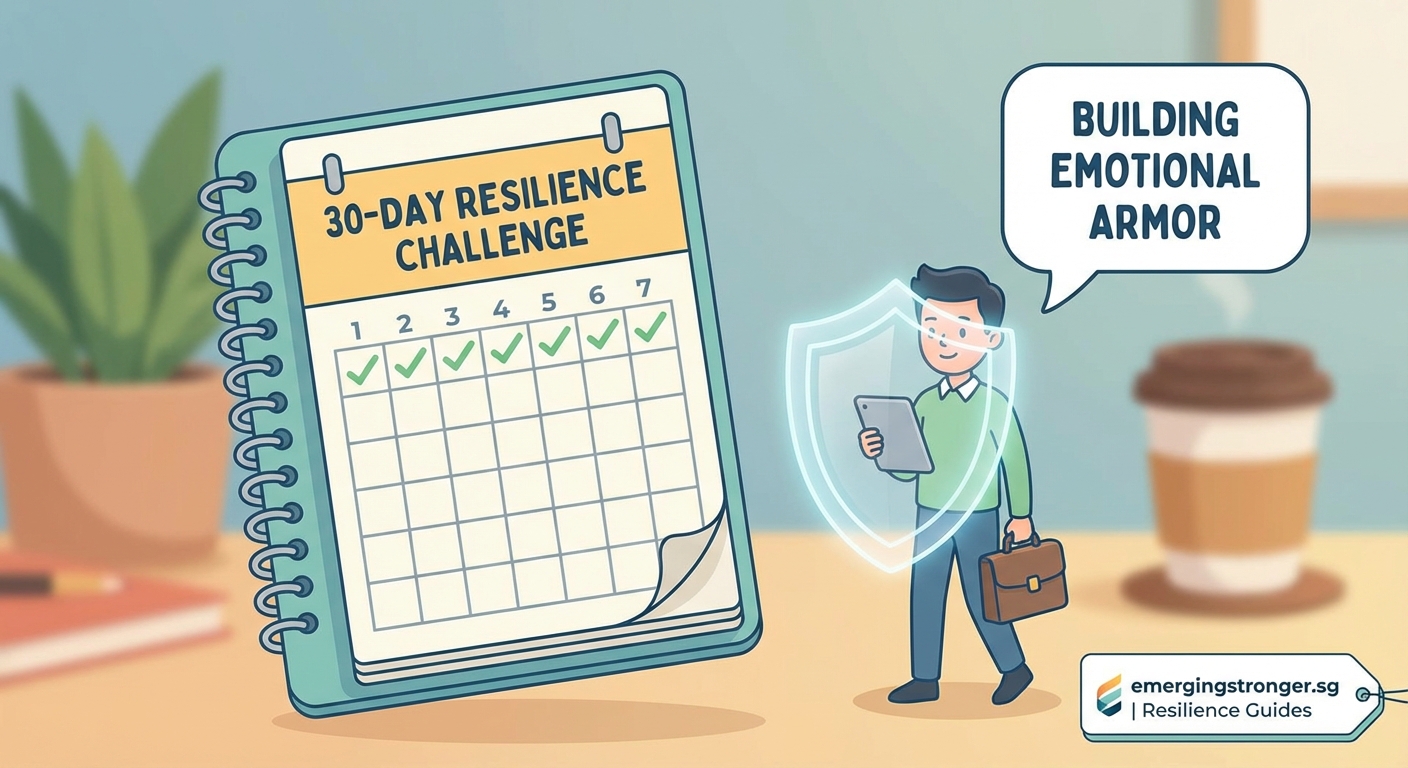
The challenge includes a simple daily check-in system.
| Metric | How to Measure | Frequency |
|---|---|---|
| Stress Level | 1-10 scale rating | Twice daily |
| Practice Completion | Yes/No checkbox | Each practice |
| Energy Level | Low/Medium/High | Evening only |
| Sleep Quality | 1-5 scale | Morning only |
| Resilience Moments | Brief description | As they occur |
You’re not aiming for perfect scores. You’re gathering data about your patterns and triggers.
Missing a day doesn’t reset your progress. Resilience building follows the 80/20 principle. Completing 80% of practices yields significant benefits. Perfectionism is the enemy of consistency.
“Resilience isn’t about never falling down. It’s about getting up one more time than you fall. The professionals who succeed in this challenge aren’t the ones who execute perfectly. They’re the ones who show up imperfectly but consistently.” — Dr. Sarah Tan, Clinical Psychologist, Singapore
Common Obstacles and Practical Solutions
Obstacle 1: Forgetting Daily Practices
Set three phone alarms corresponding to your practice times. Label them with specific practice names, not just “Resilience Challenge.”
Better yet, anchor practices to existing habits. Do your morning primer while your coffee brews. Complete your midday anchor when you return from lunch. Start your evening integration when you plug in your phone to charge.
Obstacle 2: Feeling Silly or Self-Conscious
Many professionals feel awkward doing breathing exercises at their desk or journaling in public spaces. This discomfort fades with repetition.
Start with practices you can do discreetly. Close your eyes and breathe. Nobody knows you’re regulating your nervous system. They think you’re thinking.
For journaling, use your phone’s notes app. It looks like you’re responding to messages.
Obstacle 3: Not Seeing Immediate Results
Resilience gains are cumulative, not linear. You won’t feel dramatically different after day three. You might not notice significant changes until week two or three.
That’s normal and expected.
The professionals who benefit most from mental resilience techniques understand that small, consistent actions compound over time. Trust the process even when it feels unremarkable.
Obstacle 4: High-Stress Weeks Derailing Progress
The challenge will coincide with work crises, family emergencies, or unexpected demands. That’s not a bug. It’s a feature.
These high-pressure periods are exactly when you need resilience practices most. They’re also the best opportunities to test what you’re learning.
On overwhelming days, complete just one practice. The morning primer alone maintains momentum and prevents the all-or-nothing thinking that kills habit formation.
Adapting the Challenge to Your Context
Singapore’s work culture presents unique stressors. Long hours, competitive environments, and cultural expectations around emotional expression require contextual adaptation.
For those in client-facing roles: Focus extra attention on emotional regulation practices in week three. Your ability to manage frustration, disappointment, or anxiety while maintaining professional composure is a high-value skill.
For those in leadership positions: Week four’s connection and meaning work becomes particularly important. Your resilience directly impacts team morale and performance. Leaders who model healthy stress management create psychologically safer workplaces.
For those experiencing major transitions: If you’re dealing with career setbacks or professional uncertainty, the cognitive flexibility work in week two provides critical reframing skills. You’ll learn to view challenges as temporary and specific rather than permanent and pervasive.
For those with limited privacy: Adapt practices to fit your living situation. Many exercises work in shared spaces. Breathing techniques are silent and invisible. Thought records can be done mentally before transcribing them later.
What Success Actually Looks Like
Resilience gains manifest in subtle but significant ways.
You’ll notice you recover from frustrating meetings faster. The commute home stops feeling like you’re carrying the office on your shoulders. Sunday evening anxiety about Monday morning decreases.
You might find yourself responding to criticism with curiosity instead of defensiveness. Or choosing a constructive conversation over silent resentment. Or recognizing when you need support and actually asking for it.
These aren’t dramatic transformations. They’re incremental upgrades to your emotional operating system.
The goal isn’t to eliminate stress or negative emotions. That’s neither possible nor desirable. The goal is to increase your capacity to experience difficulty without it derailing your wellbeing or performance.
Building Support Systems During the Challenge
Resilience develops in relationship, not isolation.
Consider recruiting a colleague or friend to complete the challenge alongside you. Daily check-ins create accountability and provide opportunities to share insights and troubleshoot obstacles together.
If you prefer community support, Singapore offers several mental health resources where you can connect with others working on similar goals.
For those who value privacy, online forums and apps provide anonymous spaces to track progress and exchange experiences with other busy professionals.
The key is some form of external accountability. Internal motivation fluctuates. External structures keep you moving forward when enthusiasm wanes.
Beyond Day 30
The 30 day structure provides a contained experiment. It’s long enough to establish habits but short enough to commit to even when you’re skeptical.
What happens on day 31 matters more than what happens on day 1.
By the end of the challenge, you’ll have identified which practices deliver the most value for you personally. Not every technique works equally well for every person. That’s fine.
Your post-challenge practice might look like:
- Maintaining 2-3 core practices daily
- Rotating through different techniques weekly
- Returning to intensive practice during high-stress periods
- Integrating resilience work into broader personal growth plans
The challenge isn’t the destination. It’s the on-ramp to sustainable resilience practice.
Measuring What Matters
Beyond daily tracking, conduct three formal assessments.
Baseline Assessment (Day 0):
– Rate your current stress level (1-10)
– Identify your three biggest stressors
– Describe your typical stress response patterns
– Note your current coping strategies
Midpoint Check (Day 15):
– Reassess stress level
– Identify which practices feel most helpful
– Note any changes in stress response patterns
– Adjust practices based on what’s working
Final Assessment (Day 30):
– Complete final stress level rating
– Document observable changes in resilience
– List practices you’ll continue
– Set post-challenge intentions
This data provides concrete evidence of progress that might otherwise go unnoticed. Small improvements in daily stress ratings or sleep quality accumulate into significant quality of life gains.
When to Seek Additional Support
This challenge complements but doesn’t replace professional mental health support.
If you’re experiencing persistent symptoms of anxiety, depression, or burnout that interfere with daily functioning, consult a mental health professional. Resilience practices work best as preventive maintenance and skill-building, not crisis intervention.
Warning signs that indicate you need more support include:
- Sleep disturbances lasting more than two weeks
- Persistent feelings of hopelessness or worthlessness
- Difficulty concentrating that affects work performance
- Physical symptoms like chest pain, headaches, or digestive issues
- Increased reliance on alcohol or other substances
- Thoughts of self-harm
Singapore offers accessible mental health services through both public and private channels. Starting with your GP can help you navigate options and referrals.
Real Stories from Singapore Professionals
Michelle, a 34-year-old marketing manager, completed the challenge during a particularly demanding product launch.
“I was skeptical that 15 minutes a day would make any difference when I was working 12-hour days. But the practices gave me anchors. The morning breathing exercise became my transition from home mode to work mode. The evening journaling helped me actually leave work stress at the office instead of ruminating all night.”
She didn’t eliminate stress. She changed her relationship with it.
David, a 41-year-old finance professional, found the cognitive flexibility week most valuable.
“I realized I was catastrophizing everything. A client complaint became ‘I’m terrible at my job.’ A missed deadline became ‘My career is over.’ The thought record exercises helped me see how distorted my thinking had become. Now I catch myself and ask, ‘What’s the evidence?’ It sounds simple, but it’s been transformative.”
These aren’t exceptional outcomes. They’re typical results when professionals commit to consistent practice.
Starting Your Challenge Tomorrow
You don’t need special equipment, apps, or preparation to begin.
You need:
– A notebook or digital note-taking tool
– Three 5-minute blocks in your daily schedule
– Willingness to feel awkward initially
– Commitment to 80% completion
Download a simple tracking template or create your own. Set your alarms. Identify your practice locations.
Then start.
Day one won’t feel revolutionary. You’ll do a three-minute breathing exercise and wonder if this is really going to help. That doubt is normal. Do it anyway.
By day seven, you’ll notice the practice feels less foreign. By day fifteen, you’ll probably have a preferred technique. By day thirty, you’ll have data showing whether this investment paid off.
Your Resilience Toolkit Awaits
Building emotional armour isn’t about becoming invulnerable. It’s about developing the capacity to absorb impact, recover faster, and maintain your core stability when external circumstances shake you.
This 30 day resilience challenge provides a structured path through that development. It respects your time constraints while delivering evidence-based practices that create measurable change.
The professionals who emerge stronger aren’t the ones who avoid adversity. They’re the ones who build the skills to meet it effectively. Your challenge starts whenever you decide you’re ready to invest 15 minutes a day in your mental fitness. The question isn’t whether you have time. It’s whether you’re willing to prioritize it.