Getting retrenched or hitting a major career wall feels like a punch to the gut. One moment you are climbing the corporate ladder at a Raffles Place office, and the next you are staring at a farewell email wondering where it all went wrong. Many Singapore professionals know this feeling all too well. But what if the path forward is not another certification or a polished CV? What if the answer lies in something more personal, more unexpected, and more human? Creative expression has helped countless individuals not just survive career setbacks but transform them into launchpads for something entirely new. Let us look at how Singapore artists have done it and how you can too.
Career setbacks can leave you feeling stuck and uncertain about your next move. Many Singaporean artists have turned professional losses into creative breakthroughs that reshaped their entire careers. This article explores how painting, writing, music, dance, and other creative practices help process difficult emotions, rebuild shattered confidence, and spark unexpected new career directions. You will learn practical techniques to channel setbacks into personal and professional growth, supported by real stories from Singapore’s vibrant creative community.
The Hidden Link Between Creative Expression and Career Recovery
When you lose a job or face a major career disappointment, the first thing that usually takes a hit is your sense of identity. Without a title, a company name, or a steady paycheck, you might feel like you have lost a part of yourself. Creative expression helps you reconnect with the parts of your identity that no job can take away. Your voice, your perspective, your unique way of seeing the world. These things remain intact even when your career falls apart.
Singapore’s competitive environment often makes us tie our self-worth to our professional achievements. We are conditioned to aim for the next promotion, the higher bonus, the better job title. When that trajectory stops, the silence can be deafening. Creative expression fills that silence with something meaningful. It gives you a way to process grief, anger, and confusion without needing to have everything figured out.
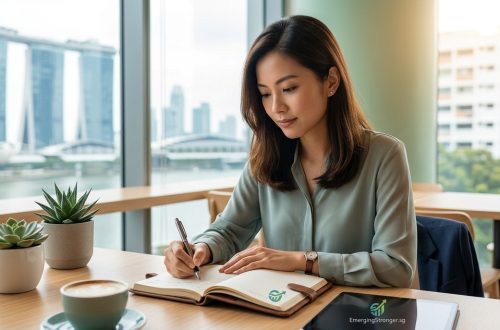
For many Singaporeans, the idea of picking up a paintbrush or writing poetry feels foreign or even frivolous. But creative expression does not have to mean becoming a full time artist. It can be as simple as journaling for ten minutes at a hawker centre, taking photographs during a walk at East Coast Park, or learning a few chords on a ukulele. The goal is not mastery. The goal is movement. Forward movement through a difficult season.
What Singapore Artists Teach Us About Bouncing Back
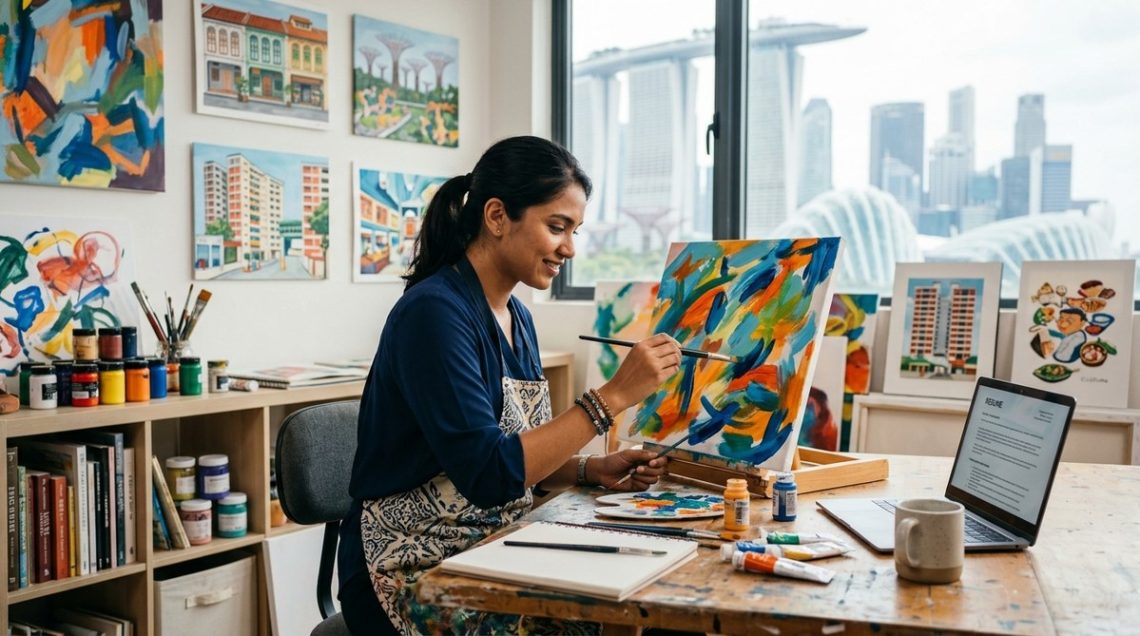
Local artists have long understood something that many corporate professionals overlook. Setbacks are not the end of your story. They are raw material for your next chapter. Consider the painter who was retrenched from a marketing role during the pandemic. She spent her first month of unemployment in a daze, scrolling through job listings that all seemed to lead nowhere. Then she picked up a brush for the first time since secondary school. She started painting scenes from her childhood in a HDB estate in Toa Payoh. Those paintings became a series that eventually landed her a solo exhibition at a gallery in Gillman Barracks. Today she runs workshops helping other professionals use art to navigate career transitions.
Or consider the writer who received rejection after rejection from publishers in Singapore. He had left a stable job in finance to pursue his dream of writing a novel. Friends told him he was being reckless. Family members worried about his future. But he kept writing, documenting the stories of elderly uncles and aunties at his local kopitiam. That collection of stories went on to win a literary prize and was adapted into a theatre production. He now speaks at schools about resilience and the courage to follow an unconventional path.
“Creative expression gave me a way to rewrite my own narrative. When my career fell apart, I felt like a failure. But each painting reminded me that I am still here, still creating, still capable of making something beautiful out of the mess.” — Aisha Rahman, visual artist and former marketing executive
These stories share a common thread. These individuals did not wait until they had everything figured out before they started creating. They used creative expression as a tool to make sense of their situation, to process their emotions, and to slowly rebuild their confidence. The art did not fix their problems overnight. But it gave them a reason to get up in the morning and a way to see themselves differently.
Why Creative Expression Works When Nothing Else Does
There is actual science behind why creative expression helps with career setbacks. When you engage in a creative activity, your brain enters a state of focused relaxation. This state reduces cortisol levels and increases dopamine, which improves your mood and helps you think more clearly. It also activates the default mode network in your brain, which is responsible for connecting different ideas and generating new insights. This is why solutions to problems often surface when you are doing something creative rather than when you are staring at a spreadsheet.
Creative expression also helps you process complex emotions that are difficult to put into words. You might not be ready to talk about how you feel after being retrenched. But you can paint it. You can dance it. You can write a song about it. The act of externalising your emotions through a creative medium makes them feel more manageable. You are no longer drowning in your feelings. You are shaping them into something you can observe and understand.
For Singapore professionals who are used to solving problems with logic and structure, creative expression offers a different kind of intelligence. It taps into intuition, playfulness, and experimentation. These are qualities that get suppressed in many corporate environments. Reconnecting with them can help you discover career paths you had never considered. This is why so many people who go through career setbacks end up in entirely different industries. They gave themselves permission to create, and in the process, they discovered what they truly wanted to do.
3 Practical Steps to Start Your Creative Recovery
You do not need to be an artist to benefit from creative expression. Here is a straightforward process that any Singapore professional can follow, whether you are between jobs or simply feeling stuck in your current role.
-
Choose a low-stakes creative outlet. Pick something that requires no previous experience and no expensive equipment. Write three pages in a notebook every morning. Take ten photographs on your phone during your lunch break. Doodle on a scrap paper while you drink your kopi. The key is to choose something that feels playful rather than performative. If you put pressure on yourself to be good, you will miss the point.
-
Set a tiny, repeatable habit. Do not wait for inspiration to strike. Commit to five minutes a day, no more. Set a timer on your phone and stop when it rings. This small commitment bypasses your inner critic and builds momentum. Over time, those five minutes will expand naturally. You might find yourself writing for half an hour or sketching for an entire evening. But start small enough that you cannot say no.
-
Reflect on what you create. Once a week, look back at what you have made. Ask yourself what themes keep showing up. Are you drawn to certain colours, words, or sounds? What emotions are surfacing? This reflection turns creative expression from a simple activity into a tool for self discovery. You might notice patterns that point you toward a new career direction or a passion you had forgotten.
This framework works because it removes the pressure to produce something impressive. You are not creating for an audience. You are creating for yourself. The process is the point.
Which Creative Practice Suits Your Recovery Style?
Different people need different kinds of creative expression depending on their personality and their current emotional state. The table below outlines three common approaches and the practices that fit each one.
| If you feel… | Try this practice | Why it helps | Common mistake to avoid |
|---|---|---|---|
| Overwhelmed and scattered | Slow, repetitive handwork like knitting, colouring, or clay sculpting | The repetitive motion calms your nervous system and gives your mind a break from racing thoughts | Jumping into complex projects that require decision making when you are already depleted |
| Angry or frustrated | High-energy outlets like drumming, dancing, or abstract painting with bold strokes | Physical expression releases pent-up tension and transforms anger into something visible and manageable | Suppressing the intensity or trying to make something “pretty” instead of letting it be raw |
| Numb or disconnected | Sensory practices like baking, gardening, or working with textured materials | Engaging your senses brings you back into your body and helps you feel present again | Choosing passive activities like scrolling social media instead of hands on making |
Take an honest look at where you are emotionally right now. Pick the practice that matches your state, not the one that looks most impressive on Instagram. The right creative practice will feel like a release, not another chore.
Small Creative Habits You Can Start This Week
If you are still unsure where to begin, here are several low effort ideas that fit easily into a Singapore professional’s busy schedule. No studio space required.
- Take a different route home from work and photograph five things you have never noticed before
- Write a six word memoir about your current career situation and share it with one trusted friend
- Rearrange the furniture in your room as a physical metaphor for creating new space in your life
- Cook a dish you have never tried before, following only your intuition instead of a recipe
- Record a voice memo describing your ideal day five years from now, without editing or censoring yourself
- Collect objects from a walk in your neighbourhood and arrange them into a temporary sculpture
Each of these acts takes less than fifteen minutes. None of them requires talent or training. They simply ask you to show up and play. Over time, these small habits rebuild your creative muscles and remind you that you are capable of making something new.
How Creative Expression Connects to Broader Resilience
Using creative expression to cope with career setbacks is one piece of a larger resilience puzzle. It works best when combined with other strategies that support your mental and emotional health. For example, learning to rebuild your confidence after a major career setback in Singapore involves both internal work and practical steps. Creative expression helps with the internal part. It gives you a private space to process, experiment, and regain a sense of agency.
If you are currently navigating a difficult career transition, consider pairing your creative practice with other proven approaches. You might find it helpful to read about how Singaporeans are rebuilding their careers after setbacks in 2026 for additional inspiration and practical guidance. The combination of inner work and outer strategy creates a powerful foundation for long term recovery.
Creative expression also connects you to a community of people who have walked similar paths. Singapore has a growing network of creative workshops, community art spaces, and writing groups where professionals gather to make sense of their experiences together. Joining one of these groups can reduce the isolation that often accompanies career setbacks. You realise you are not alone. Other people are figuring it out too, one brushstroke or one sentence at a time.
Your Creative Comeback Starts Today
Career setbacks have a way of making you feel small. They shrink your world to the size of your disappointment. Creative expression does the opposite. It expands your world. It reminds you that you are bigger than your job title, bigger than your salary, bigger than the setback that knocked you down. You have a voice. You have a perspective. You have something to say that no one else can say quite the same way.
The Singapore artists who have turned their career losses into creative wins did not have a special talent that you lack. They simply gave themselves permission to start. They made space for imperfection. They trusted the process even when the outcome was unclear. You can do the same.
Pick one small creative act today. Write a single sentence. Draw a wobbly line. Hum a tune that has been stuck in your head. Let it be messy. Let it be incomplete. Let it be yours. That is how every comeback begins. Not with a grand plan but with a small, brave act of creation.