
When the lights went out across parts of Singapore during the 2019 power outage, many families realised they weren’t as prepared as they thought. No torches. No backup charger. No plan for what comes next. That moment of uncertainty hit hard, especially for parents trying to keep children calm while fumbling in the dark.
Creating a family emergency preparedness plan isn’t about being paranoid. It’s about building confidence that your household can handle whatever comes your way, whether it’s a natural disaster, sudden job loss, or a health crisis that turns life upside down.
A family emergency preparedness plan combines clear communication protocols, essential supplies, financial buffers, and regular practice drills. Singapore households need plans that address both physical emergencies like floods and personal crises like retrenchment. The most effective plans involve every family member, get reviewed twice yearly, and balance practical preparation with emotional resilience. Building this foundation helps families respond with confidence rather than panic.
Understanding what your household actually faces
Before you stock up on batteries and canned food, you need to know what risks matter most for your specific situation.
Singapore families face a unique mix of challenges. Flooding can happen during monsoon season, especially in low-lying areas. Health emergencies strike without warning. Job loss affects even stable industries. Fires, though rare, can devastate HDB flats within minutes.
But your family’s risk profile depends on more than geography. Do you have elderly parents living with you? Young children with specific medical needs? A single income supporting the household? These factors shape what “prepared” actually means for your family.
Start by listing the three most likely emergencies your household could face in the next year. Be honest. If your industry has been restructuring, job loss belongs on that list. If your toddler has asthma, a health crisis might rank higher than a natural disaster.
This assessment isn’t meant to scare you. It’s meant to focus your energy where it matters most. You can’t prepare for everything, but you can prepare for the things most likely to affect your family.
Building your communication framework
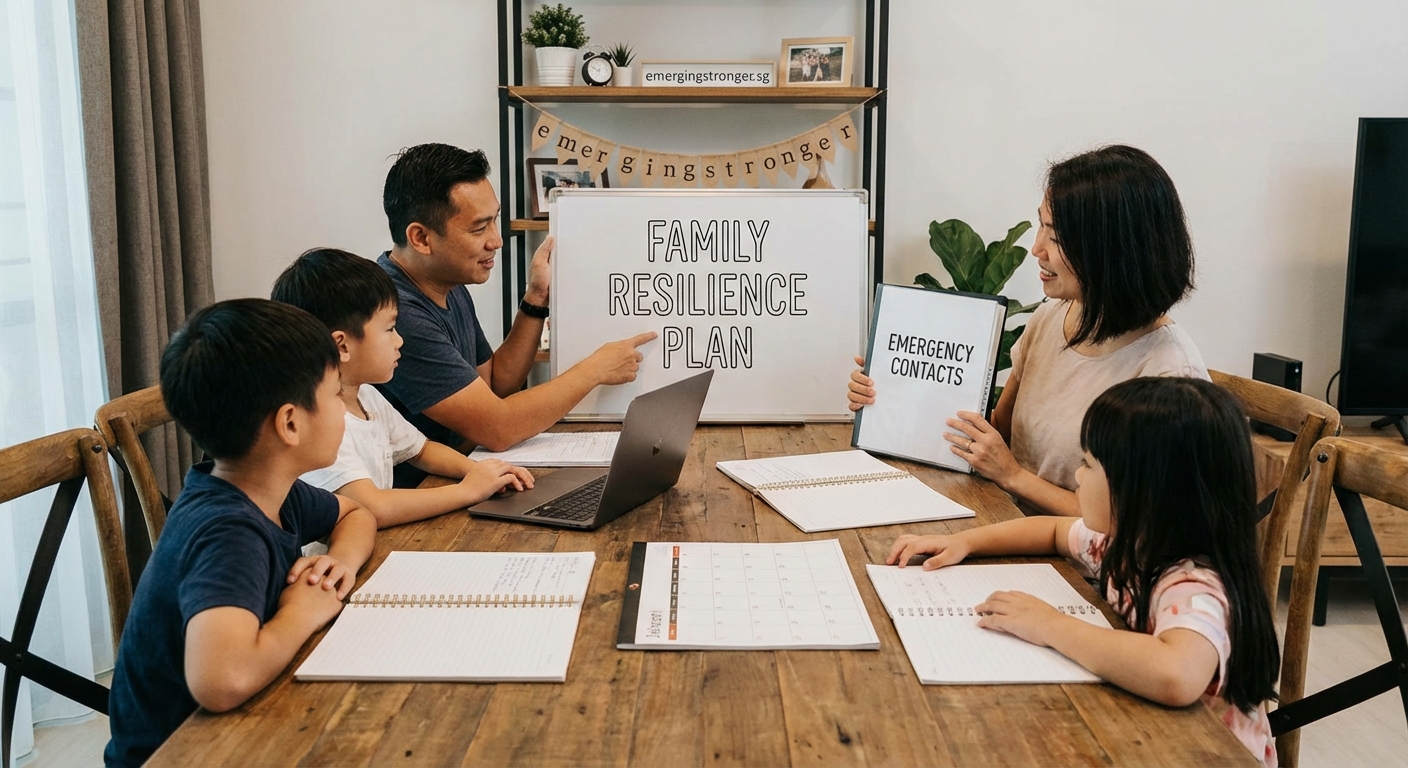
When crisis hits, communication often breaks down first. Phone lines jam. WhatsApp groups explode with conflicting information. Panic spreads faster than facts.
Your family needs a communication plan that works even when technology fails.
Create a contact card for every family member
Each person should carry a physical card listing:
- Emergency contact numbers for all household members
- One out-of-state contact (someone outside Singapore who can relay messages)
- Meeting locations if you can’t reach home
- Medical information and allergies
- Insurance policy numbers
Yes, physical cards. Your phone might be dead, lost, or out of coverage when you need this information most.
Establish clear meeting points
Pick three locations:
- Right outside your home (for minor emergencies like a small fire)
- Outside your neighbourhood (if you can’t return home)
- Outside Singapore (if evacuation becomes necessary)
Make sure every family member, including children, can describe how to reach these spots. Practice the route to your neighbourhood meeting point during a weekend walk.
Set up a group chat protocol
Create a dedicated emergency WhatsApp group separate from your regular family chat. Use it only for real emergencies and monthly check-ins. This prevents the “cry wolf” effect where important messages get lost in daily chatter.
Designate one person as the primary communicator who updates the group during a crisis. Too many voices create confusion.
The resilience toolkit for navigating uncertainty includes communication strategies that work under pressure, helping families stay connected even when stress runs high.
Stocking supplies that actually matter
Walk into any hardware store and you’ll find emergency kits packed with items you’ll never use. The goal isn’t to buy everything. It’s to have what your specific household needs for 72 hours of self-sufficiency.
Essential supplies every Singapore household needs
Water and food basics
- 3 litres of water per person per day (9 litres per person for three days)
- Non-perishable food that your family will actually eat (no point stocking sardines if everyone hates them)
- Manual can opener
- Paper plates and utensils to conserve water
Power and light
- Torches with extra batteries (one per family member)
- Portable phone charger, fully charged
- Battery-powered radio for emergency broadcasts
- Candles and matches in waterproof container
First aid and medication
- Basic first aid kit with bandages, antiseptic, pain relievers
- One-month supply of prescription medications
- Copies of prescriptions
- Contact lens solution if anyone wears lenses
- Children’s fever medication
Important documents
Store copies in a waterproof bag:
- Identity cards
- Birth certificates
- Insurance policies
- Bank account information
- Property documents
- Medical records
- Recent family photos (for identification if separated)
Personal items
- Change of clothes for each person
- Toiletries and sanitary supplies
- Cash in small denominations ($500 minimum)
- Whistle for signaling help
- Dust masks
Supplies for specific household needs
| Household Type | Additional Items Needed |
|---|---|
| Families with infants | Formula, bottles, nappies, baby food, comfort items |
| Elderly members | Mobility aids, hearing aid batteries, denture supplies, extra medications |
| Pet owners | Pet food, water, leash, carrier, vaccination records, recent photo |
| Medical conditions | Glucose monitor, insulin cooler, oxygen supply, dialysis information |
Store these supplies in a designated cupboard or storage box that everyone knows about. Check expiration dates every six months, ideally during the same weekend you change smoke detector batteries.
“The families who recover fastest aren’t always the ones with the most supplies. They’re the ones who know exactly where their supplies are and how to use them without thinking. Practice matters more than perfection.” – Civil Defence instructor, 15 years experience
Preparing for financial emergencies
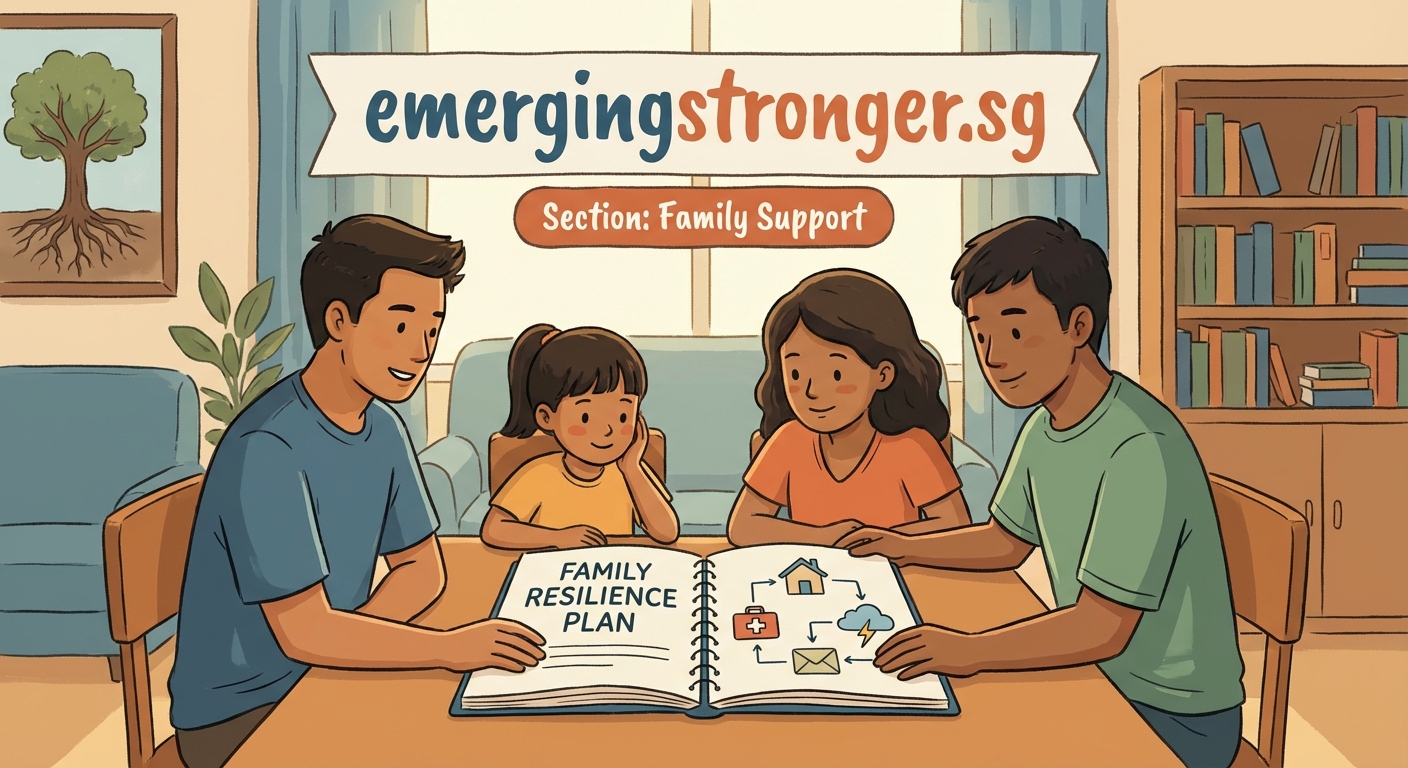
A medical crisis or job loss can devastate your household finances faster than any natural disaster. Your family emergency preparedness plan needs a financial component.
Build your emergency fund systematically
The standard advice is six months of expenses. That’s overwhelming for most families. Start smaller.
- Save $1,000 as fast as possible (sell items, take on extra work, cut non-essentials)
- Build to one month of expenses
- Grow to three months
- Aim for six months over time
Even $1,000 creates breathing room when the unexpected hits. It covers urgent car repairs, emergency dental work, or a replacement phone when yours dies before payday.
The guide on building a six-month emergency fund in Singapore breaks down practical steps for any income level, showing how small consistent actions build real financial resilience.
Document your financial landscape
Create a simple spreadsheet listing:
- All bank accounts and balances
- Insurance policies and coverage amounts
- Monthly bills and due dates
- Debts and minimum payments
- Income sources
- Government benefits you qualify for
Share this document with your spouse or a trusted family member. Store a printed copy with your emergency supplies.
If something happens to you, your family needs to know where money lives and what bills need paying. This isn’t morbid. It’s practical love.
Know your safety nets
Singapore offers support during financial crises, but you need to know what exists before you need it:
- ComCare for short-term assistance
- Workfare Income Supplement
- MediShield Life and MediFund for medical costs
- CPF withdrawals under specific circumstances
Research these programmes now. Bookmark the application pages. Understand eligibility requirements. When crisis hits, you won’t have mental energy for research.
For families facing job loss, the resource on navigating Singapore’s retrenchment support programmes provides step-by-step guidance through available assistance.
Teaching children to respond without fear
Your emergency plan only works if every family member knows their role. That includes children.
Age-appropriate preparation builds confidence without creating anxiety. A five-year-old doesn’t need to know about job loss scenarios, but they should know what to do if they smell smoke.
For young children (ages 3 to 7)
- Teach them to recognise emergency vehicles and uniforms
- Practice “stop, drop, and roll” as a game
- Help them memorise one parent’s phone number
- Show them how to call 995
- Create a comfort bag with a favourite toy, book, and snack
For primary school children (ages 8 to 12)
- Explain different types of emergencies in simple terms
- Teach them your meeting point locations
- Practice the route to your neighbourhood meeting spot
- Show them where emergency supplies are stored
- Assign them a specific responsibility (like grabbing the pet carrier)
For teenagers (ages 13+)
- Include them in planning discussions
- Teach them basic first aid
- Show them how to shut off utilities if needed
- Give them a copy of your emergency contact list
- Discuss financial basics like emergency funds
Run practice drills twice a year. Make them low-pressure. Time how long it takes everyone to grab their go-bag and reach the meeting point. Treat it like a fire drill at school, routine rather than scary.
The approach to teaching resilience to children helps parents build emotional strength alongside practical preparedness, creating kids who can handle uncertainty with confidence.
Practising until response becomes automatic
A plan sitting in a drawer isn’t a plan. It’s a wish. Real preparedness comes from practice.
Schedule family emergency drills every six months. Put them on the calendar like dental appointments. Make them non-negotiable.
Drill variations to practice
- Fire drill (everyone out of the flat in under three minutes)
- Power outage (navigate home using only torches)
- Communication breakdown (reach each other without phones)
- Evacuation drill (pack go-bags and reach meeting point)
- Medical emergency (practice calling 995 and giving clear information)
Time each drill. Note what went wrong. Adjust your plan based on what you learn.
During one family’s practice evacuation, they discovered their emergency cash was in a safe only Dad could open. When he wasn’t home during the drill, no one could access it. They moved half the cash to a location Mum could reach. Small discovery. Big impact.
Review and update quarterly
Set a recurring reminder to review your plan every three months. Check:
- Are phone numbers still current?
- Have medications expired?
- Do children’s clothes in the go-bag still fit?
- Has anyone developed new medical conditions?
- Have financial circumstances changed?
- Do meeting points still make sense?
Life changes constantly. Your plan needs to change with it.
Common mistakes that undermine preparedness
Even well-intentioned families make planning errors that create false confidence. Avoid these traps.
| Mistake | Why It Fails | Better Approach |
|---|---|---|
| Assuming someone else will handle it | Confusion and delays during actual emergencies | Assign specific roles to each person |
| Storing all supplies in one location | If that area is inaccessible, you have nothing | Keep go-bags in multiple spots (home, car, office) |
| Planning only for natural disasters | Most families face financial or health crises first | Address all likely scenarios, not just dramatic ones |
| Never testing the plan | Reveals gaps only during real emergencies | Practice drills twice yearly minimum |
| Forgetting about pets | Pets get left behind or complicate evacuation | Include pets in every aspect of planning |
| Using only digital records | Power outages and dead phones make them useless | Keep physical copies of critical documents |
| Skipping the financial component | Leaves families vulnerable to common crises | Build emergency fund alongside physical supplies |
The biggest mistake? Thinking preparation is a one-time task. It’s an ongoing practice, like maintaining your health or your home. Small regular efforts matter more than one intense planning session.
Connecting your plan to mental resilience
Physical supplies and communication protocols matter. But the most prepared families also build emotional resilience that helps them stay calm when crisis hits.
Stress management isn’t separate from emergency planning. It’s central to it. When your child is crying, the power is out, and you can’t reach your spouse, your ability to manage your own anxiety determines how well your family copes.
The techniques in mental resilience strategies for professionals apply directly to family crisis management, helping parents model calm leadership when everyone else is panicking.
Build resilience practices into daily life
- Practice breathing techniques for stress management so they’re automatic during crisis
- Discuss setbacks openly as a family, normalising challenges
- Celebrate small wins in preparation (like completing a drill successfully)
- Maintain connections with extended family and neighbours who can help
Understanding why some people bounce back faster helps you build those same qualities in your household, creating a family culture that views challenges as manageable rather than catastrophic.
Create emotional safety alongside physical safety
Your emergency plan should address both types of security. Make sure family members feel safe asking questions, expressing fears, and admitting when they don’t understand something.
A teenager who’s too embarrassed to admit they don’t remember the meeting point won’t ask for clarification. Then when emergency strikes, they’re lost.
Create a culture where not knowing is fine, but staying ignorant isn’t. Review the plan together. Let everyone ask questions. Update based on their input.
For families navigating difficult transitions, the strategies in building stronger family bonds during financial hardship show how crisis can actually strengthen relationships when handled with intention and care.
Extending preparedness beyond your household
Your family doesn’t exist in isolation. Your preparedness connects to your neighbours, your community, and your support network.
Build neighbourhood connections now
Know your neighbours. Not just their names, but their situations. Who has elderly parents? Who has medical training? Who has a generator? Who might need help evacuating?
Exchange phone numbers with at least three nearby households. Create a neighbourhood WhatsApp group for emergencies.
During the 2020 circuit breaker, the families who coped best were those already connected to neighbours. They could coordinate grocery runs, share supplies, and check on each other. That social infrastructure didn’t appear overnight. It existed because someone built it during normal times.
Identify your support network
List five people outside your household who you could call during different types of emergencies:
- Who can you stay with if you can’t access your home?
- Who can pick up your children if you’re stuck somewhere?
- Who can lend money if you face sudden expenses?
- Who can provide emotional support during crisis?
- Who has skills you lack (medical training, financial knowledge, etc.)?
Don’t assume. Ask these people directly if they’re willing to be part of your emergency network. Offer to reciprocate.
The resource on finding your support network helps identify and strengthen these crucial relationships before you need them urgently.
Share what you learn
As you build your family emergency preparedness plan, share your process with friends and family. Your preparation might inspire theirs.
Talk about your drills. Mention what worked and what didn’t. Normalise these conversations. The more families in your circle who are prepared, the stronger your entire community becomes.
Making preparedness part of your family culture
The most effective emergency plans aren’t treated as special projects. They’re woven into the fabric of family life.
Keep your emergency supplies visible, not hidden away. When children see the emergency kit regularly, it becomes normal rather than scary. They understand that prepared families take sensible precautions, just like wearing seatbelts or locking doors.
Talk about what to do in the first 48 hours after a major setback as casually as you’d discuss weekend plans. Resilience becomes part of your family identity.
Celebrate your preparation milestones. When you complete your first drill successfully, order pizza. When you reach your first $1,000 in emergency savings, acknowledge it together. These small celebrations reinforce that preparation is valuable and achievable.
Start this week, not someday
You don’t need to complete everything at once. Start with one action this week:
- Schedule a family meeting to discuss emergency planning
- Buy a torch and batteries for each family member
- Create a contact card and make everyone carry it
- Set up your emergency WhatsApp group
- Research one government support programme
- Save your first $50 toward your emergency fund
Pick one. Do it this week. Then pick another next week.
Progress beats perfection. A partial plan you actually have beats a perfect plan you never create.
Your family’s resilience starts with simple steps
Building a family emergency preparedness plan might feel overwhelming at first. All those supplies to gather, plans to make, drills to run. But you don’t have to do everything today.
Start where you are. Use what you have. Do what you can.
The family who survives a crisis isn’t always the one with the most supplies or the most detailed plan. It’s the family who practiced enough that response became automatic. The family who built emotional resilience alongside physical preparation. The family who knew they could handle uncertainty because they’d proven it to themselves in small ways first.
Your household faces real risks. Job loss. Health emergencies. Natural disasters. Financial shocks. But you also have real capabilities. The ability to plan. To practice. To adapt. To support each other through difficulty.
That combination of honest risk assessment and genuine capability is what preparedness really means. Not fearlessness. Not perfect control. Just the quiet confidence that whatever comes, your family has thought it through and knows what to do next.
Start building that confidence this week. Your future self will thank you.