
Your spouse just lost their job. The news lands like a punch to the gut, and suddenly the future feels uncertain. Bills still need paying. The kids still need school fees. And somewhere between the shock and the scrambling, your relationship needs to survive this storm intact.
Job loss doesn’t just happen to one person. It happens to both of you. And in Singapore’s high-pressure environment where career success often defines identity, unemployment can shake your partner’s confidence to its core. But here’s what most people don’t realize: how you respond in these first few weeks can either strengthen your marriage or create cracks that last for years.
Supporting your spouse through job loss requires emotional presence, practical financial planning, and daily actions that rebuild confidence. This guide covers five evidence-based strategies Singaporean couples use to navigate unemployment together, from managing immediate reactions to accessing government support programmes. Job loss can actually strengthen relationships when partners approach it as a shared challenge rather than an individual crisis.
Managing your own emotional response first
Before you can truly help your partner, you need to check your own reaction. This sounds backwards, but it’s critical.
When your spouse loses their job, you might feel panic about money. Anger at their former employer. Fear about the future. Or even resentment if you’re now the sole breadwinner. These feelings are normal. They’re also contagious.
Your partner is already dealing with shame, anxiety, and identity crisis. If you’re radiating panic, you’re adding fuel to their fire.
Take 24 hours to process your own emotions before trying to be supportive. Call a friend. Write in a journal. Go for a run at East Coast Park. Do whatever helps you think clearly.
“The biggest mistake I see couples make is trying to ‘fix’ the situation immediately. The unemployed partner needs space to grieve their loss before they can start problem-solving. And the employed partner needs to manage their own anxiety before they can offer real support.” – Family therapist at Singapore Counselling Centre
Here’s what helps in those first few days:
- Acknowledge that this affects both of you
- Give your partner permission to feel upset without rushing to solutions
- Set a specific time to discuss finances (not immediately)
- Maintain normal routines where possible
Creating a judgment-free zone for honest conversations
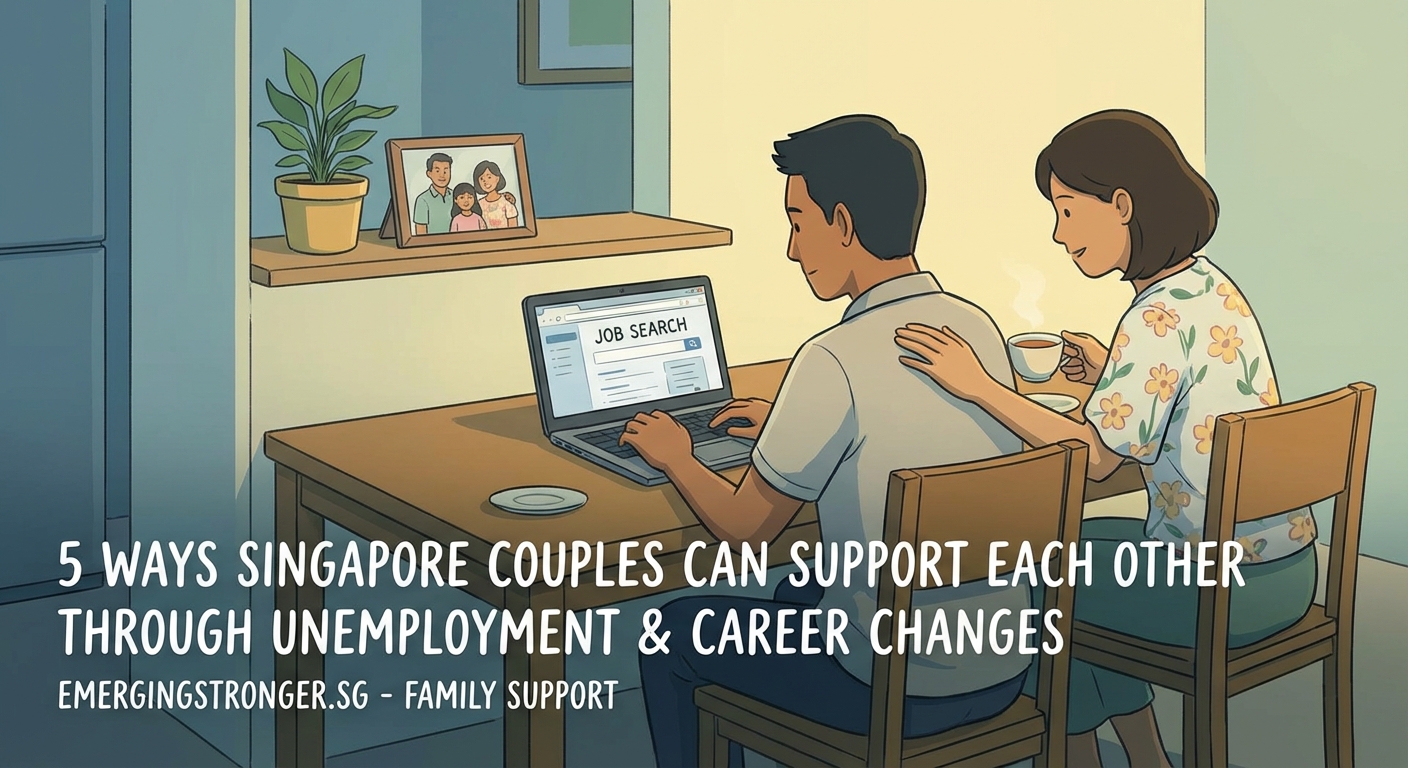
Your home needs to become a safe space where your spouse can talk about their fears without being met with panic or criticism.
This is harder than it sounds. When money is tight, every conversation can feel loaded. Your partner mentions wanting to switch industries, and you’re mentally calculating how long the savings will last. They sleep in one morning, and you wonder if they’re giving up.
But here’s the thing: your spouse needs emotional safety before they can rebuild professionally. And that starts with how you listen.
Set up a daily check-in time. Fifteen minutes. No phones. No TV. Just talking about how they’re feeling that day. Not what jobs they applied to. Not whether they’ve heard back from recruiters. Just feelings.
During these conversations:
- Listen without offering solutions unless asked
- Validate their emotions even if you don’t fully understand them
- Ask open-ended questions like “What was the hardest part of today?”
- Avoid comparing their situation to others who “had it worse”
- Never say “At least you…” or “You should be grateful that…”
The science of resilience shows that emotional support is the strongest predictor of how fast someone bounces back from setbacks. Your partner doesn’t need you to be a career counsellor right now. They need you to be a witness to their struggle.
Tackling financial planning as a team
Money stress can destroy marriages faster than almost anything else. But it doesn’t have to.
Within the first week, sit down together and create a survival budget. Not a lecture. Not a scolding. A collaborative plan that both of you build together.
Start by listing all your current expenses:
| Category | Current Monthly Cost | Can We Reduce? | New Target |
|---|---|---|---|
| Mortgage/Rent | $2,500 | No | $2,500 |
| Groceries | $800 | Yes | $600 |
| Transport | $400 | Yes | $250 |
| Insurance | $300 | Review | $300 |
| Utilities | $150 | Slightly | $120 |
| Dining Out | $500 | Yes | $100 |
| Entertainment | $300 | Yes | $50 |
Be realistic about what you can cut. Eliminating all joy from your lives will only create more stress. Keep some small pleasures. That weekly kopi session. The occasional movie. These aren’t luxuries during unemployment. They’re pressure valves.
Next, calculate your runway. How long can you survive on savings? Three months? Six months? Knowing this number reduces anxiety because uncertainty is often worse than bad news.
Then navigate Singapore’s retrenchment support programmes together. Your spouse might qualify for:
- Career Support Programme (CSP) allowance
- SkillsFuture credits for training
- Workfare Income Supplement if they take a lower-paying job
- Temporary financial assistance from Social Service Offices
Research these options together. Make the calls together. This isn’t just about getting help. It’s about showing your partner they’re not alone in this fight.
Supporting the job search without becoming a nag

There’s a fine line between being supportive and being controlling. Your spouse knows they need to find work. Reminding them daily doesn’t help. It just creates resentment.
Instead, ask how you can be useful. Maybe they need you to:
- Review their resume with fresh eyes
- Practice interview questions
- Take over more household tasks so they can focus on applications
- Give them space during the day without checking in constantly
Some partners want accountability. Others want autonomy. Don’t assume. Ask.
One practical approach: agree on a weekly update schedule. Every Sunday evening, your spouse shares what they accomplished that week and what they’re planning for the next one. This keeps you informed without requiring daily reports.
If your partner seems stuck or unmotivated, resist the urge to criticize. Instead, help them rebuild confidence after this career setback by celebrating small wins. They updated their LinkedIn? That’s progress. They reached out to a former colleague? That took courage. Acknowledge it.
Also recognize that job searching in Singapore is exhausting. Your spouse might send out 50 applications and hear nothing back. They might have three rounds of interviews and still get rejected. This isn’t a reflection of their worth. It’s just the reality of a competitive market.
Building resilience through daily rituals
Unemployment can make days blur together. Without the structure of work, your spouse might struggle with motivation and purpose. You can help by creating new routines together.
Start mornings with a walk. Even 20 minutes around the neighbourhood helps. Exercise reduces anxiety and gives the day a clear beginning.
Encourage your partner to maintain professional habits even without a job. Getting dressed. Keeping regular hours for job searching. Taking a proper lunch break. These small actions preserve their sense of identity as a working professional.
But also make space for mental resilience techniques that actually work. This might include:
- Gratitude journaling each evening
- Meditation or breathing exercises
- Regular video calls with supportive friends
- Volunteering or side projects that provide purpose
The goal isn’t to fill every moment with productivity. It’s to create enough structure that your spouse doesn’t spiral into depression while maintaining enough flexibility that they don’t feel controlled.
Plan something to look forward to each week. A free concert at the Botanic Gardens. A picnic at Marina Barrage. A home-cooked meal from a new recipe. These moments remind both of you that life continues even during hard times.
Knowing when to seek professional help
Sometimes love and support aren’t enough. If your spouse shows signs of depression that last more than two weeks, it’s time to get professional help.
Warning signs include:
- Sleeping much more or less than usual
- Loss of interest in activities they normally enjoy
- Talking about feeling worthless or being a burden
- Withdrawing from friends and family
- Significant changes in appetite
- Difficulty concentrating even on simple tasks
Singapore has free mental health services that can help. Don’t wait until things get worse. Early intervention makes a huge difference.
You might also benefit from couples counselling. Job loss changes relationship dynamics. The person who was the primary earner might struggle with feeling dependent. The person who’s still working might feel overwhelmed by new responsibilities. A therapist can help you navigate these shifts before they damage your relationship.
And don’t forget about finding your support network. You need people to talk to as well. Other spouses who’ve been through this. Friends who can listen without judgment. Your own support system matters too.
Protecting your relationship during the transition
Job loss creates stress. Stress creates conflict. But conflict doesn’t have to create distance.
Set some ground rules for fighting fair:
- No bringing up past mistakes during arguments
- No threats of leaving or divorce
- Take breaks if discussions get too heated
- Focus on specific issues, not character attacks
- Apologize when you’re wrong
Also protect your intimacy. Physical connection often suffers during unemployment because stress kills desire. But maintaining affection, even small gestures like holding hands or hugging, keeps you bonded during tough times.
Plan date nights that don’t cost money. Cook dinner together. Watch the sunset from a HDB rooftop. Play board games. The activity matters less than the intentional time together.
Remember why you chose each other in the first place. This crisis is temporary. Your marriage doesn’t have to be a casualty of it.
What successful couples do differently
The couples who emerge stronger from unemployment share some common habits. They treat job loss as a shared problem, not an individual failure. They communicate openly about money without blame. They celebrate small victories. And they maintain hope even when progress feels slow.
They also recognize that this transition might lead somewhere better. Many Singaporeans who lost jobs during the pandemic found second careers that were more fulfilling than their original path. Sometimes a forced change becomes an unexpected gift.
Your spouse might discover they want to switch industries. Or start a business. Or pursue training in a new field. These possibilities only emerge when you create space for them to think beyond immediate survival.
Support doesn’t mean having all the answers. It means showing up consistently. Listening without judgment. Managing your own anxiety. And believing in your partner’s ability to rebuild even when they don’t believe in themselves yet.
Moving forward together
Job loss tests marriages. But tests can make you stronger if you face them as a team.
Your spouse needs you to be their safe harbour right now. Not their drill sergeant. Not their therapist. Not their career coach. Just their partner who refuses to let this crisis define them or your relationship.
The practical steps matter. The budgets and the job applications and the government programmes. But what matters more is showing your spouse that their worth isn’t tied to their employment status. That you’re committed to weathering this storm together. That you still see the capable, valuable person they are, even when they can’t see it themselves.
This period will end. Your spouse will work again. And when they do, you’ll both have learned something invaluable about resilience, partnership, and what it means to truly support someone through their darkest moments. That knowledge will serve your marriage long after the job search is over.
Start today with one small action. One conversation. One gesture that says “we’re in this together.” That’s how you support your spouse through job loss. Not with grand gestures or perfect solutions, but with consistent, loving presence every single day.